This article aims to examine the research trend of sport history by analysing published research articles over the last decade in the Korean Journal of History for Physical Education, and suggest directions of research in sport history based on the results. We have reviewed a total of 264 articles relying on the analytic framework including the criteria of time period, method, nation, theme/topic, and purpose. The research findings are as follows. First, the post-Liberation period has been studied most often with 45.3%, followed by the Japanese Colonization period (20.2%), the Joseon Dynasty period (11.4%), the diachronic research (8.8%), the period from ancient times through Goryeo (8.1%), and the period of Enlightenment (6.2%). The results indicate that most recent studies in the journal unilaterally focus on the Modern and Contemporary history with 71.7%. According to the analysis result by research method, second, more than 90% of the studies have been conducted using qualitative methods while only 0.6% of the papers have adopted quantitative methods. The qualitative methods include textual analysis, participant observation, oral life story, and focus group interview. Textual analysis has been used most often with 74.5%. Oral life story has been second (22.5%), followed by participant observation (2.1%) and focus group interview (0.3%). The findings from this category show that it is still necessary to diversify research methods and vitalize interdisciplinary research. Third, in terms of nation, over 70% of the papers have studied about Korea, and European countries are the second most frequent region in the research trend (8.3%). The nation that follows is China with 6.4%. Although we analysed a Korean journal in sport history, the result exposes the lack of scholarly attention in the studies of sport history to world sport history reflecting comparative perspectives. By the criteria of theme/topic, fourth, genre has been studied most often with 31.7%, followed by figure (14.1%), facility/institution/organization (14.0%), system/policy/event (12.8%), philosophy/ideology/theory (6.7%), remains/relics/documentary material (6.3%), and domestic regions (5.4%). The results show that the recently published research articles have attempted to include a variety of genres in sports, play, and dance. While the topics for figure and facility/institution/organization also receive significant interest, it is limited that the studies mostly focus on male sport figures but female figures are barely explored. Even when female figures are researched, the attempts are observed only in the studies of dance. Fifth, the largest ratio of papers has had the research purpose of historical evolution (37.6%), followed by value/significance (20%), type/characteristic (15.5%), thoughts/ideology/theory (9.1%), origin (6.6%), suggestion/proposal/prediction (5%), comparison/correlation (5%), and concept/terminology (1.2%). The results expose that the studies tend to concentrate on historical evolution relying on chronological description while the research on concept/terminology is of little scholarly interest. Based on what we have found, it is identified that the recent studies in sport history have mostly focused on the historical evolution of a specific sport genre in the Korean Modern and Contemporary history using textual analysis. Consequently, the results suggest that researchers in sport studies need to put in additional effort to expand research topics and methods, and invite comparative perspectives involving inter/cross-national studies.
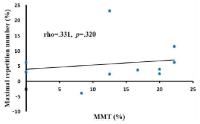
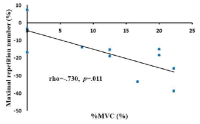
The purpose of this study was to determine whether maximum repetition number can be used as an indicator of strength imbalance. Eleven healthy, resistance-trained males were tested for one repetition maximum (1-RM) the chest-press exercise, and than manual muscle testing (MMT), two-arm at 80% of 1-RM and one-arm at 40% of 1-RM in the pectoralis major were measured for the maximum voluntary contraction (%MVC) and maximum number of repetitions during the chest press exercise. Exercise velocity was constantly 4 seconds (concentric: 2-s, eccentric: 2-s) per repetition. The changes in %MVC were significantly higher in non-dominant limb (NDL) compared with dominant limb (DL) pectoralis major during two-arm chest press (p < 0.01) and one-arm chest press exercise (p < 0.05). In contrast, the changes in MMT (p < 0.05) and maximum repetition number (p < 0.01) were significantly higher in DL compared with NDL during one-arm chest press exercise. There was no correlation between maximum repetition number and MMT (rho = 0.331, p = 0.320). However, maximum repetition number was significantly negative correlated with %MVC in two-arm chest press (rho = -0.730, p = 0.011). It is possible that maximum repetition number can be used as an indicator of strength imbalance.
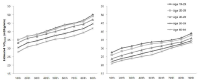
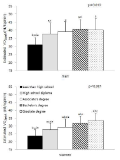
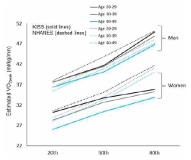
To provide the distribution of cardiorespiratory fitness including Bruce treadmill exercise time and estimated peak oxygen uptake (VO2peak) and investigate association with cardiorespiratory fitness and metabolic syndrome, sedentary lifestyle, or education level among Korean adults. Analysis of data on 2,006 adults (19-64 yr) who had completed a maximal grade treadmill exercise test, from the Sports Institute of Sports Science Fitness Standards (KISS FitS) project 2014-2015. The mean maximal exercise time was 11’26’‘, 11’18’‘, 11’06’‘, 10’03’‘ and 8’51’‘ (minutes and seconds) for men 19-29, 30-39, 40-49, 50-59 and 60-64 years of age, respectively, for women, it was 9’49’‘, 9’09’‘, 8’42’‘, 8’01’‘ and 7’33’‘ for the corresponding age groups. The mean peak oxygen uptake was estimated as 42.3, 41.8, 41.2, 37.6 and 33.6 ml/kg/minute for men 19-29, 30-39, 40-49, 50-59 and 60-64 years of age, respectively, For women, it was 34.0, 31.8, 30.3, 28.0 and 26.4 ml/kg/minute for the corresponding age groups. A positive association between cardiorespiratory fitness level and education level was observed for both men and women. Furthermore, participants with sedentary lifestyle had a significantly lower cardiorespiratory fitness than participants with activity lifestyle. Finally, Men with moderate and high fitness level had 50% and 87% lower odds for the metabolic syndrome, and women had 48% and 50% lower odds for the metabolic syndrome, respectively, than the ones with low fitness level after adjustment for age, smoking, alcohol intake, and sedentary lifestyle. These results can be used to track future Korean assessments and to evaluated interventions. The differences in fitness status by education level, sedentary lifestyle or metabolic syndrome can also be used to develop health policies, program and educational services.
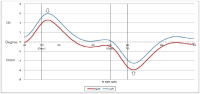
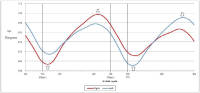
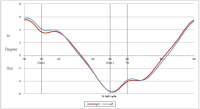
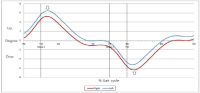
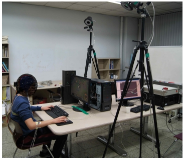
The purposes of this study were to establish gait reference data for 20s Korean and to analysis between Korean and foreigner. Male 34 and female 36 were selected for a subject group in accordance with the classification system of Korean standard body figure and age by Korean Agency for Technology and Standard. The sample size was calculated by GPower which is used for power analysis. The power of this study was 80.7%. 3D motion capture system and force platform were used to measure in this study. Gait data were collected by 8 cameras and 2 force platform. Each camera was operated at 120 frames/sec for sampling frequency and 1/1000 sec for shutter speed. The sampling frequency of force platform was 1200Hz. As a result of the study, the following results were obtained. A statistically significant difference in analysis between gender and within gender was appeared differently dependent on whether or not standardized. No significant difference appeared between legs for a female group in all temporospatial variables. But the significant difference with support time ratio and swing time ratio appeared for a male group. In analysis between gender, a significant difference appeared about walking speed and cadence. In pelvic tilt, a significant difference between right and left was found only in frontal plane for a male but found in a frontal plane and a horizontal plane for a female. In analysis between gender, a significant difference was found in sagittal plane both legs. In conclusion, normal gait pattern between gender was different and showed the difference between Korean and foreigner.
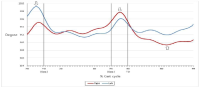
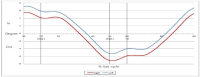
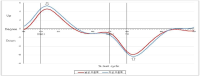
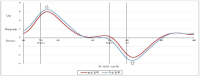
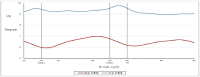
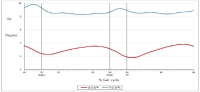
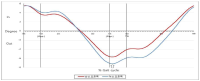
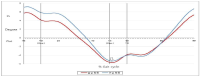
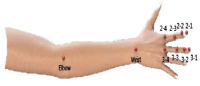
The purpose of this study was to determine how acute active pc-video game affects kinematic variables and muscle activities of adolescents. Fourteen middle school students(age: 15.9±0.7 yrs, height: 171.3±6.1cm, weight: 60.0±5.4 kg, right handed) who have no musculoskeletal disorder were recruited as the subject according to having experience in using the pc-video game for more than six months. Maximum angle, angular velocity, and muscle activity of the upper extremity were determined for each trial. For each dependent variable, a paired t-test was performed to test if significant difference existed between pre- and post a 60 minute active pc-video game(p<.05). This study found that one hour pc-video game hour may not affect on movement and ROM of the finger and the wrist, whereas it may have an effect on muscle activity of the upper extremity. It seems that repetitive movement pattern during an active pc-video game may hinder muscle activity of adolescents’ upper extremity. Part of the increase in musculoskeletal disorders is linked to the amount of time adolescents are allowed to play video games. This study found that an active pc-video game appears to have negative effects on the upper extremity muscles. Since wrist movements are continually repeated throughout the video game, carpal tunnel syndrome may possibly be caused by long-term exposure to video games.
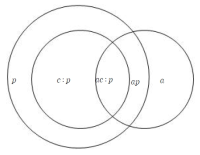
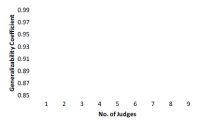
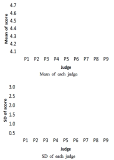
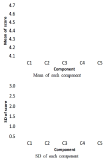
The purpose of this study was (1) to analyze judges’ evaluation on figure skating performance and statistical analysis and (2) to make recommendation to improve judges' performance. Data were 62 figure skaters’ scores from Senior Woman 1 Group Part at 2015 The National Figure Skating Championship in Korea. Data of presentation part in Short Program were analyzed. Presentation part consists of skating skills, transitions/linking footwork/movement, performance/execution, choreography/composition and interpretation. Nine judges evaluate skater's presentation with the score 10.0 for each factor. Generalizability theory, descriptive statistics and ANOVA were utilized. Results showed that generalizability coefficient of presentation part was over 0.9, therefore stable reliability was secured. The error source about players has more significant impact to evaluation than other error sources. Generalizability coefficient was stable when reducing the number of judges up to 2. Also, judges generally represented aspects of similar evaluation, but different aspects appeared on a few judges’ assessment in the components of presentation. Discussions were provided in terms of the reliability of the judging method for the presentation part of figure skating and the effective measurement condition.

Sport Imagery Questionnaire of Hall et al.(1998) was developed to investigate the imagery type of athletes objectively. The purpose of this research is to verify validity and reliability of Korean SIQ by using Rasch Model, in order to make up for complement drawback of SIQ which was developed only using factorial analysis. This research conducted first and second questionnaire survey. Second survey was conducted targeting different study participants from those of first survey. The participants of first survey was 265 athletes of Chungcheong Province, and the participants of second survey was 169 athletes of Chungcheong Province. SPSS 21, Winstep 3.62, and AMOS 18 was used for date analysis. The result of Rasch Model verification for the data of first survey revealed that 8 items of SIQ were unfit. Thus, 5 factors and 22 items were determined. 7 point Likert scale was revealed to be a good fit. The result of Confirmatory Factor Analysis for the data of second survey revealed that Construct Validity of 5 factors and 22 items was valid and reliability was high by recording Cronbach’α value .954. External Validity was revealed to be high by showing that correlation between sport confidence and MG-M imagery was high.
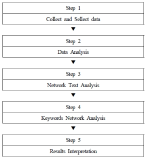
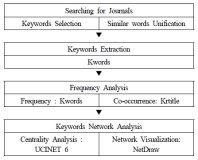
The purpose of this study was to investigate the research trends on school sports clubs using the Content Analysis and Network Text Analysis. Data included 137 journal articles published from 2007 to 2016 and were analysed using SPSS 20.0, KrKwic software and the NetDraw of UCINET 6 program.The results were as follows. First, the number of research articles on school sports clubs were increased since 2012. Second, research studies using mixed subjects were most popular in comparison to more narrow target population. Third, the mixed methods approach was less utilised in comparison to quantitative and qualitative research methods. Fourth, correlational studies were more frequently used while multivariate analyses were less common in terms of statistical methods. Fifth, satisfaction, policy, and leader were the most frequently used keywords among the keywords provided by journal articles. Lastly, the results of Network Text Analysis indicated that school sports clubs and user satisfaction showed the highest degree centrality, closeness centrality, and betweenness centrality.
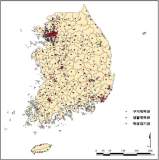
Based on public sports facilities’ census data, this study attempts to empirically analyze to the factors affecting the operating balance and use of public sports facilities(PSF). Analysis was carried out through multiple regression analysis using SPSS and location characteristics analysis using GIS. The total floor area and population was confirmed to influence operating balance and use(DV). Management body influence differed for DV (use and operating balance of PSF) by type of PSF. Consequently, this requires diversification of the management body. The size of facilities and location characteristics(population and zoning) are positive effect on the operating balance and Use of PSF. In order to solve the problem of location restriction and security of marketability, it is possible to take into account the integrated management and sports club’s use of large-scale sports facilities.
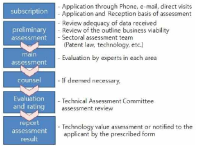
This research intends to present a new model development for properly evaluating intangible assets of sports companies. To accomplish the purpose of this research, cases where observable data such as costs are used to determine value and the application of such evaluation models were explored. Also overseas cases of Patent Litigation Fund, Patent Portfolio Fund, Intellectual Property Incubation Fund and existing loan programs were analyzed. The model development provided by this research utilizes numbers from financial statements in assessing intangible assets, thereby uniting the financial statements with actual value. And more accurate corporate evaluation method would be possible by evaluating intangible assets based on numbers from financial statements was suggested. Therefore, suggested model development first calculates the total goodwill and then divides this among the different types of intangible assets. The criteria of such division is based on the cost involved. This is much more persuasive than estimating future profits or comparing similar companies because it is based on actual cost spent and not vague numbers. This is not completely different from existing profit approach, but rather an evolved form of it. In other words, suggested model development tries to translate goodwill into tangible numbers as much as possible.