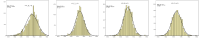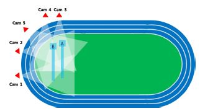
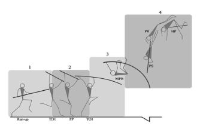
The purpose of the study was to investigate the relationship between the different kinematical variables with respect to the records and techniques performed by the participants during the 2011 Daegu IAAF World Championships Men's Pole Vault Event. Subjects chosen for the study were 8 male athletes who were selected for men's pole vault finals (highly skilled group) and 7 athletes who scored lowest record (skilled group) from the men's pole vault qualifying round. Personal best record of the each subjects were chosen to perform two dimensional (2D) and three dimensional (3D) video analyses. The data were obtained at 60 Hz with the use of five video cameras and digitizing was performed. Kinematical variables were calculated after smoothing the data using 2nd order Low-Pass Butterworth filter at cut-off frequency of 10 Hz and Independent samples t-test was performed to test any differences between two subject groups. The results: during the run-up stage, the horizontal velocity rate of the number of steps and run-up phase was obtained higher in highly skilled group than skilled group. During the take-off phase, deceleration in the horizontal velocity rate was observed in highly skilled group than skilled group. Distinct technical characteristics of distant and lower take-off of the take-off angle (angle of pole support) were also observed in highly skilled group than skilled group. During the pole bending and releasing phase, horizontal velocity was generally higher in highly skilled group than skilled group. It is considered that highly skilled group was able to jump higher as the vertical velocity during the pole bending as well as release phase was much higher in comparison to the skilled group.
The purpose of this research is to provide the information about sports injury by surveying and analyzing a result, and to lead analytic and scientific training among the subjects being elite summer sport athletes. All sports injuries are recorded on injury report form and the following results were obtained. In Cycle sport, the prevalence of injuries of the low back, knees were highest. and In Table tennis sport, the prevalence of injuries of the ankle was highest due to the chronic fatigue. The prevalence of injuries of the shoulder, low back were highest due to the overuse of joints. In Badminton sport, the prevalence of injuries of low back, knees, ankles were highest by overtraining. In Gymnastics, the prevalence of injuries of the low back, knees, ankles were highest. In Archery sport, there is a lot of injuries to the shoulder and neck. In Weight lifting sport, the prevalence of injuries of the low back, knees, and ankles were highest. In Golf sport, the prevalence of injuries of knees, low back were highest. In Hockey sport, the prevalence of injuries of ankles, knees, low back were highest. In Boxing sport, the prevalence of injuries of hands, shoulder, the low back were highest, In Judo sport, there are overall damage occurred in parts of the whole body, but the prevalence of injuries of ankles, knees, low back were highest. In Fencing sport, the prevalence of injuries of the low back, knees were highest. In Wrestling sport, although there is a difference slightly depending on freestyle and Greco-Roman, but the prevalence of injuries of knees, ankles, low back were highest. In Handball sport, the prevalence of injuries of ankles, knees were highest. In Taekwondo, the prevalence of injuries of ankles, knees, feet were highest.
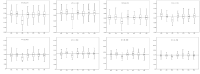
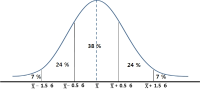
The purpose of this study was to evaluate the physical performance and develop the criteria of 4243 middle and high school students across 5 provinces (Busan, Gwangju, Daejeon, Gyeongi and Jeonbuk) in Korea that took part in the talent development project. The data was collected between 2011 and 2014. The criteria was divided by gender and age across different grades, and the mean, standard deviation and 5 evaluation levels were calculated and analyzed.