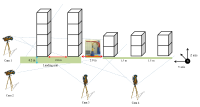
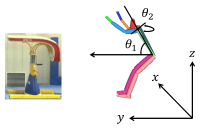
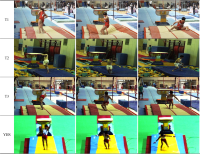
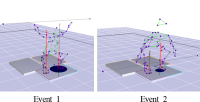
Purpose The purpose of the study was to perform a comparative analysis of the YANG Hak Seon technique carried out by "K" athlete with the kinematical data of "Y" athlete and propose a method to improve the YANG Hak Seon technique of "K" athlete. Method The subject recruited for the study was a male athlete from Korean national team (Age: 21, height: 1.65 m, body weight: 59.6 kg, and career: 11 years). Four high - speed cameras were used to analyze the 3D motion of the YANG Hak Seon technique performed by "K" athlete. The variables selected for analysis were the velocity of COM, displacement of COM, the rotational & torsional angle of the trunk and rotational & torsional angular velocity of the trunk. The results obtained were compared to the preexisting data of the "Y" athlete (data set from the published research). Results Firstly, the horizontal displacement of the YANG Hak Seon technique of the "K" athlete was observed to be shorter along with lower vertical displacement during landing compared to “Y” athlete. In addition, the overall horizontal velocity was low and vertical velocity was not generated which rises during the BC (board contact) phase. Although the rotational angular velocity of the trunk was lower during the BC, HC (horse contact) phase and LD (landing) phase, torsional angular velocity was higher during the LD. Conclusion In order to improve the completeness of the YANG Hak Seon technique of the K player, it is necessary to enter with a fast and low posture on the footplate during the initial phase. In the BC phase, it is essential to raise the COM simultaneously while landing on the footplate and increase the rotational angular velocity of the trunk.
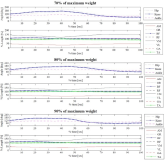
Purpose The purpose of this study was to identify the lower extremity muscles length change according to the increase of the weight during snatch. Also, through the muscle contraction velocity analysis, it is necessary to identify muscles that require rapid muscle contraction. Methods The subjects were 10 national weight-lifters. Their mean age was 29 ± 3.84 yrs, body weight 71.3 ± 16.04 kg, height 1.63 ± 0.07 m, and the highest recorded height 128 ± 36.30 kg. Experiments were performed during the snatch to 70%, 80%, and 90% of the individual highest records. The analysis variables were the lower extremity angle, angular velocity, muscle length and muscle contraction velocity and were calculated by biomechanical modeling. Statistical analysis was performed with a repeated measure with one-way ANOVA to analyze the difference between the increase weight (70%, 80%, 90% of peak) and the dependent variable (angel, angular velocity, muscle length and muscle contraction velocity). Results According to the results of the study, there was no statistical difference in angle, angular velocity and muscle length with increasing weight. However, in the comparison of the muscle length, muscle length of the vastus medialis, vastus lateralis, biceps femoris, rectus femoris were statistically higher than other muscles. Also muscle contraction velocity of the rectus femoris, biceps femoris, vastus medialis, vastus lateralis, rectus femoris were statistically higher than other muscles. Conclusion In the snatch, the dominant muscles were the muscles around the femur, and the co-contraction of biceps femoris and great adductor muscles would contribute to improve the performance.
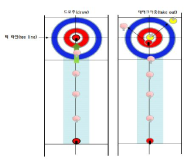
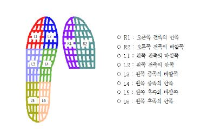
In this paper, we tried to find out the difference of CoM displacement, CoM velocity and Foot-pressure between draw motion and takeout motion in curling’s delivery motion. To do this, we experimented for 10 female athletes of curling national team(all athletes are in her 20th~30th ages) to carry out draw motion and takeout motion from backline to near hogline in state of speed limit. The limited speed was 3.80~3.90 sec for draw and 2.97~3.07 sec for takeout. From the experiments, we obtained the result like followings. 1. Draw motion is more increase than takeout motion in displacement of horizontal direction of CoM displacement. 2. Takeout motion is more increase than draw motion in displacement of vertical direction of CoM displacement. 3. Takeout motion is faster than draw motion in both of horizontal and vertical direction of CoM max. velocity. 4. Takeout motion is higher than draw motion in pressure of fore-foot and mid-foot of foot-pressure 5. Draw motion is higher than takeout motion in pressure of fore-foot and mid-foot of foot-pressure These result means that the characteristics of techniques for draw motion and takeout motion is differ from each other and it is necessary to take different training protocol individually to enhance athletes’s performance. And further research will contains another things like that the pursuit of curling stone’s rut by various delivery techniques



The purpose of this research is to provide the information about sports injury by surveying and analyzing a result, and to lead analytic and scientific training among the subjects being elite summer sport athletes. All sports injuries are recorded on injury report form and the following results were obtained. In Cycle sport, the prevalence of injuries of the low back, knees were highest. and In Table tennis sport, the prevalence of injuries of the ankle was highest due to the chronic fatigue. The prevalence of injuries of the shoulder, low back were highest due to the overuse of joints. In Badminton sport, the prevalence of injuries of low back, knees, ankles were highest by overtraining. In Gymnastics, the prevalence of injuries of the low back, knees, ankles were highest. In Archery sport, there is a lot of injuries to the shoulder and neck. In Weight lifting sport, the prevalence of injuries of the low back, knees, and ankles were highest. In Golf sport, the prevalence of injuries of knees, low back were highest. In Hockey sport, the prevalence of injuries of ankles, knees, low back were highest. In Boxing sport, the prevalence of injuries of hands, shoulder, the low back were highest, In Judo sport, there are overall damage occurred in parts of the whole body, but the prevalence of injuries of ankles, knees, low back were highest. In Fencing sport, the prevalence of injuries of the low back, knees were highest. In Wrestling sport, although there is a difference slightly depending on freestyle and Greco-Roman, but the prevalence of injuries of knees, ankles, low back were highest. In Handball sport, the prevalence of injuries of ankles, knees were highest. In Taekwondo, the prevalence of injuries of ankles, knees, feet were highest.
PURPOSE The purpose of this study was to verify the support effect of muscle activity and stability according to walking conditions (Level, Ramp, and Stair) before and after wearing a suit with a 12kg heavy weight load. METHODS To accomplish the purpose of the study, subjects (n=10) underwent Electromyography (EMG) measurement under the same conditions for 10 different muscles, and COP width was calculated through foot pressure measurement. The experimental movement was level walking, Ramp walking, and stair walking, each carrying a 12kg load, and measured once before and after wearing a wearable suit. RESULTS Electrolyography (EMG) measurement revealed a significant difference in the average EMG values of muscle activity of R.RF in level walking(p<.05), R.RF and L.RF in ramp walking(p<.01), L.RF and L.BF in stair walking (p<.05). COP width measurement revealed a significant difference in the reduction of COP width in all walks (level walking, ramp walking, stair) (p<.05, p<.01, p<.001). CONCLUSIONS The effects of wearing a wearable suit are as follows. First, the wearable suit has a significant effect of assisting the Rectus Femoris muscle. Second, there is a gait stability effect by wearing a wearable suit.
