
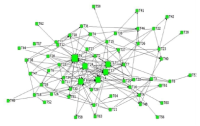
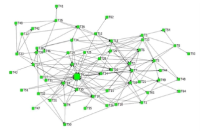
Previous work has shown that coaches sought information from several sources; however, there was a strong reliance on learning from other coaches within their social networks. There has been limited research examining the nature of these social networks with other coaches (Trudel and Gilbert 2004). Thus the purpose of this study was to examine the structures of coaches’ social networks of Korean rhythmic gymnasts. Research questions were: (1) What are the network structures of Korean rhythmic gymnasts’ coaches? (2) What structural parameters contribute to coaches’ network structures, and (3) Is there an association between coaches’ network and flow of information in their networks? A total of 37 coaches of youth rhythmic gymnasts (6-18 years old) participated in this study. Each of those coaches was asked to complete a Name Generator Questionnaire (i.e., list four names that you have a close relationship with) and general socio-demographic survey. Data were analyzed using social network analysis tools such as UCINET, p-net, and Quadratic Assignment Procedure. Analysis of network centrality, density, and strong components showed that (1) homophily was identified in the structure of coaches’ social networks (2) homophily (e.g., by gymnasts’ ranking, mentor coaches) contributed to the total social network of coaches, and (3) interacting only with close coaches in the network, coaches received information about coaches/coaching from the strong ties rather than weak ties (Granovetter, 1973). This study also has strong links to Wenger’s (1998) community of practice which posited that groups of people share a common characteristic in practice.

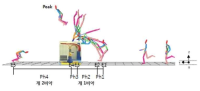
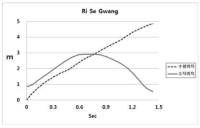
The aim of this study was to acquire essential information regarding Ri Se Gwang motion(element group Ⅱ, difficulty 6.4 point, double Tsukahara with tucked 1/1 twist), which Ri Se Gwang of North Korea performed during the final vault event of artistic gymnastic at Incheon Asian Game 2014, by analyzing motional characteristics. Firstly, Ri Se Gwang technique had second jump airborne time of 1.07 seconds and airborne height of 2.91m, which have great influences on the success of technique while having horizontal and vertical velocity of 2.73 m/s and 3.87 m/s, respectively, at the takeoff. These were sufficient jump motion for successful accomplishment of the technique however flight pattern was somewhat small which was mainly oriented vertically when compared to previous studies of Yeo and YANG Hak Seon 2 techniques. Secondly, blocking angle of vault contact was small at 9 degrees while having very small takeoff angle of 79 degrees. However, it had fast average trunk rotational velocity of 545 deg./s at the vault contact phase by rapidly bending trunk from the board takeoff until approaching the vault leading to achieve fast trunk rotational velocity of 452 deg./s after the take off in order to complete the airborne rotation successfully. Thirdly, the preparation phase of Ri Se Gwang technique had a distinct characteristics that the trunk was rapidly bent during the approach to the vault attempting aggressive blocking which leads to vertically oriented flight. It showed that this characteristic assists the motion of thigh snatch and the regulation of twist which strengthen airborne rotation for airborne rotational motion. And it also showed that sufficient landing and twist angles at the landing phase are possible with free rotational motion if the height of second jump reaches 3 m.



Purpose The purpose of this study is to analyze the performance contents of men's floor exercise and to provide basic materials for achieving excellent results at world competitions. Methods Teams ranked 1 - 12 who participated in the World Championships' floor movement group competition selected a total of 59 players by the convenience sampling method and carried out technical statistics, frequency analysis, member variable variance analysis, and post hoc analysis. Results First, as a result of frequency analysis of the difficulty of each group, all the teams ranked 1 to 12 liked the most difficulty of C and found that they do not like the F difficulty the most. Secondly, there was a difference in average for each group's start score, ranking 1st to 4th> 5th to 8th> 9th to 12th place. Thirdly, there was a difference in average of difficulty levels for each group B, C, E, and it became very significant with E difficulty.Results of post hoc analysis B difficulty (9th to 12th> 1st to 4th, 5th to 8th), C difficulty (9th to 12th> 1st to 4th), E difficulty (1st to 4th> 5th to 8th ·9th to 12th). Conclusion These results show that in floor exercise, the art of more than C difficulty and the connection technology of A, B, C, difficulty, E and F, difficult difficulty such as difficulty, creative and dynamic performance composition is excellent It clearly states that it is a condition for getting results.

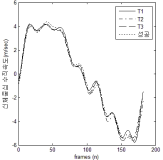
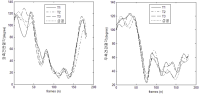
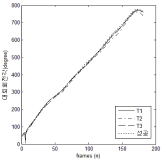
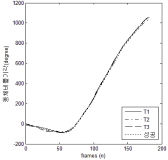
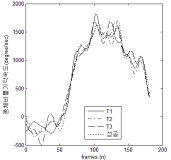
The research was a case study conducted in order to develop a new technique “YANG Hak Seon 2” for YHS athlete. A comparative kinematical three dimensional video analysis was performed with the use of high speed cameras. One successful trial and three of failure trials (T1: Falling backward while landing, T2: sitting reluctantly while landing, T3: Falling of sideways while landing). The result obtained from the study are as follows. Firstly when comparing the successful operation of the technique with failure trials, relatively higher landing angle was secured through increasing the thigh rotation and the body’s rotational velocity. Furthermore, despite increase in rotational velocity at twisting, stable landing was achieved through increasing the moment of inertia by spreading the left shoulder. Secondly, in case of failure trials while taking off the board, the thigh rotational angular velocity was comparatively less which ultimately affected the body position in the next phase of approach to the vault. Thus, due to the affected body position the athlete was not able to utilize the proper momentum of twist in positive direction Hence, it is considered that the velocity of center of mass might have also effected the operation not only the velocity while approaching the board.







The purpose of this research is to provide the information about sports injury by surveying and analyzing a result, and to lead analytic and scientific training among the subjects being elite summer sport athletes. All sports injuries are recorded on injury report form and the following results were obtained. In Cycle sport, the prevalence of injuries of the low back, knees were highest. and In Table tennis sport, the prevalence of injuries of the ankle was highest due to the chronic fatigue. The prevalence of injuries of the shoulder, low back were highest due to the overuse of joints. In Badminton sport, the prevalence of injuries of low back, knees, ankles were highest by overtraining. In Gymnastics, the prevalence of injuries of the low back, knees, ankles were highest. In Archery sport, there is a lot of injuries to the shoulder and neck. In Weight lifting sport, the prevalence of injuries of the low back, knees, and ankles were highest. In Golf sport, the prevalence of injuries of knees, low back were highest. In Hockey sport, the prevalence of injuries of ankles, knees, low back were highest. In Boxing sport, the prevalence of injuries of hands, shoulder, the low back were highest, In Judo sport, there are overall damage occurred in parts of the whole body, but the prevalence of injuries of ankles, knees, low back were highest. In Fencing sport, the prevalence of injuries of the low back, knees were highest. In Wrestling sport, although there is a difference slightly depending on freestyle and Greco-Roman, but the prevalence of injuries of knees, ankles, low back were highest. In Handball sport, the prevalence of injuries of ankles, knees were highest. In Taekwondo, the prevalence of injuries of ankles, knees, feet were highest.
Purpose This study was carried out for the purpose of providing national players of our country by grasping various techniques and difficulty composition of world-level players. Methods For doing so, this research was executed by objecting 9 finalists in parallel bar of 2012 London Olympics and 8 finalists in parallel bar of 2016 Rio Olympics. Collected datum were treated with average, standard deviation, percentage (%) by using SPSS 18.0, and they was analyzed while securing feasibility through expert meeting. Results Research results are same as follows. First, Rio Olympics players appeared higher than London Olympics such like 6,61 points in average D-score of 2012 London Olympics final game and 7.0 points in average D-score of Rio Olympics final game. Second, I group was turned up to prefer Healy technique (34.88%) of D difficulty in two olympics. Third, Ⅱ group carried out Bwd. uprise and salto fwd. p. to sup technique of D difficulty by each 4 players (36.35%) in two olympics, so the technique was displayed as preferred techniques of players. Fourth, Ⅲ group executed at the London Olympics, C difficulty was the most frequently used, but at the Rio Olympics, D difficulty and E difficulty were the most frequent. Fifth, Players in London Olympics and Rio Olympics executed Basket to hdst technique, and it appeared to be most preferred technique by players. Sixth, Ⅴ group executed at the London Olympics, D difficulty was the most frequently used, but at the Rio Olympics, F difficulty was the most frequent. Conclusions These findings will be useful datum to gymnasts and instructors of our country by providing valuable datum in preparing 2020 Tokyo Olympics after grasping preferred techniques and trends of world-excellent players.
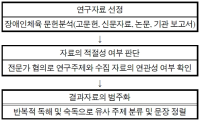
Purpose This study examines the Physical Education curriculum history of special schools, and then in-depth grasps the process of how the sports environment for the disabled has changed by age. Method The research method was literature review analyzing papers, reports and newspapers. For the concrete process, this study verified the relationship between the research subject and the collected data through experts and historians with disabilities to verify the sports data for the disabled. Results First, the process of physical education management of special schools is as follows. in the 1940's and 50's special schools, physical education was carried out simply by gymnastics. but, special schools were differentiated by the characteristics of the disabled, and the institutional foundation for physical education was also imitated by the 1960s, 1970s and 1980s, special schools were shortened in physical education time due to the increase in the number of courses and the strengthening of disability coping programs. in the 1990s, as special sports curriculum was established, customized prescription for students with disabilities was implemented. Second, the process of changing disability sports is as follows. In the 1960s and 1970s, disability sports were mainly focused on special schools, while in the 1980s, disability sports were expanded by the government. in particular, the hosting of the 88 Seoul Olympics and Seoul Paralympics provides an opportunity to equip the disabled with a system, organization and facilities. in the 1990s disability sports was meaningful in terms of academic progress, and with the quantitative growth of the 1980s and the academic foundations of the 1990s, disability sports in the 2000s provided a legal basis and improved welfare conditions for the disabled. In the future, it is necessary to find a way to solve the value of physical education for the disabled more reasonably.
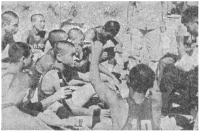
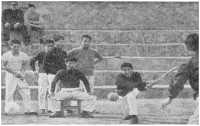
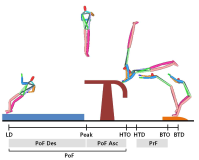
[Purpose] The purpose of this study was to compare Yeo 2 vault and YANG Hak Seon vault to verify the possibility of YANG Hak Seon vault. [Methods] The YANG Hak Seon vault and Yeo 2 vault performed by five Korean national gymnastic athletes, and the photographic images were collected using a high-speed camera and their kinematic characteristics were analyzed by 3D image analysis. [Results] The main variable of the post-flight phase S1, S4, and S2 were similar to YANG Hak Seon vault. S1 showed the largest at shoulder angle and the highest body center of mass at horse take-off. S4 showed the smallest shoulder angle at horse take-off, slow twisting at the post-flight ascending period, but faster femoral rotation during horse contact. S2 showed the slowest twist velocity in the ascending period of the post-flight and the smallest rotational distance and twist distance at the peak. S3 showed the slowest horse take-off velocity, the least time in the post-flight phase, and the hip joint was flexed at the peak. [Conclusions] S1 is required to increase the twist velocity by narrowing the shoulder angle during post-flight. S4 is required to strong push-up and an increase in the twisting velocity in the post-flight ascending period. S2 is required to shorten the horse contact time and increase the horse take-off angle through powerful femoral rotation after board take-off. S3 will have to get enough power from the preparation phase.

The aim of this study is to analyze the correlation between per capita GDP and sports items' demand and to estimate the income elasticities of sports items' demand based on the International Social Survey Programme: Leisure Time and Sports - ISSP 2007 of the GESIS(Leibniz-Institute for the Social Sciences, Germany). The facts found from the analyses are as follows; First, in general, when the correlation coefficient of a particular sports item turns out to be both positive and statistically significant, the item can be interpreted to have a good possibility to be a luxury goods and when the coefficient is ascertained to be both negative and statistically significant, the item can be inferred to have a considerable chance to be an inferior goods. In this study, other team sports(excluding basketball, soccer, volleyball, baseball etc.), squash, walking/trekking/climbing, boat sports, hunting/fishing, horse riding/horse racing, motor sports, shooting, and snow sports were confirmed to show a luxury goods' features and basketball, soccer, volleyball, athletics, and martial arts were identified to have an inferior goods' characteristics. Second, similar to the results of the correlation analysis, in the income elasticities estimation, cockfighting appeared to be an inferior goods and other team sports, squash, walking/trekking/climbing, bowling/curling/bocce, boat sports, darts, hunting/fishing, golf/minigolf, horse riding/horse racing were proved to be a luxury goods.
