
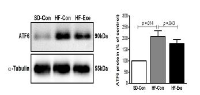
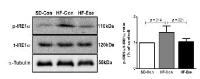
This study was to performed to the effect of 8-week endurance exercise influences on body weight, glucose tolerance and ER-stress in soleus of 16weeks Rats fed High-Fat diet. Rats were randomly assigned to 3 group; (1)Sprague-Dawley Control diet (SD-Con/n=4), (2)High-Fat diet Control (HF-Con/n=4), (3)High-Fat diet Exercise (HF-Exe/n=4). Exercise group ran on the treadmill for 30min/day at the level of 21m/min for 5days/week during 8weeks. Results showed that body weight and glucose tolerance of the HF-Con group was remarkably increased(p<.05) compared to other groups. However, HF-Exe group significantly decreased body weight and glucose tolerance compared to HF-Con group. Moreover, level of GRP78, ATF6, PERK and IER1⍺, which are main proteins of ER-stress were significantly increased in HF-Con group higher than other group, whereas HF-Exe group significantly decreased the expression of GRP78, ATF6, PERK and IER1⍺. Taken together, these finding suggested that the reduction of the body weight, glucose tolerance and unfolded protein response by treadmill exercise may represent a positive adaptation protecting against high-fat diet-induced ER stress.



The purpose of this study is to investigate the further direction of molecular biological studies, the advantages and limitations of assaying samples, and variables in figuring out the details of domestic and overseas studies verified through cell and molecular biological analysis in order to analyze the effect of concurrent training. The analysis study was limited to domestic and overseas literature, which investigated the effect of combined training using molecular biological analysis among studies to date. The study was reclassified by specialty, composed of professors of physical education and doctors of exercise physiology. The final selected study analyzed the subject and the trend of studies in terms of comprehensive perspectives. In detail, it analyzed hormonal and enzymatic changes in criteria such as leptin, 5-HT, ACTH(adrenocorticotropic hormone), cortisol, testosterone, GH(growth hormone), LDH(lactate dehydrogenase), CPK(creatine phosphokinase), antioxidants in blood samples and protein, and enzymatic and morphologic changes in for CRP, VEGF(vascular endothelial growth factor), PAI-1(plasminogen activator inhibitor-1), MAD(malondialdehyde), carnosin, and SDH(succinate dehydrogenase), the area of muscle fibers, ratio of type Ⅰ/Ⅱ muscle fiber and capillary proportion per muscle fiber in the extracted muscle by biopsy, for example. Finally, urine samples, and hormonal changes (like cortisol), were analyzed. The results of the analysis of domestic and overseas studies according to combined training has shown that this training has more varied effects than single training and lower improvement by interference effect or magnifying the effect of one type of training amongst the combined training types appears, rather than higher improvement through combined trainings. Therefore, it should be investigated in view of performance improvements relating to the characteristic of sports.

The purpose of this study was to investigate the effect of running economy and energy return in lower extremities according to the increase of bending stiffness of the shoes, furthermore to investigate the relationship between running economy and energy return for the improvement of sports performance. Subjects employed for this study were 10 healthy male college students who have not had the experiences in lower extremities injuries. Four different kinds of shoes in bending stiffness as with 0.56 N/mm, 0.74 N/mm, 0.96 N/mm, 1.21N/mm were used respectively. 3-D cinematography and pulmonary gas analyzer were utilized for energy return and energy consumption data during running according to the increase of bending stiffness of the shoes to obtain the following results. As the bending stiffness of running shoes increased, the statistical significance were not founded, however, the tendency of decrease in max. flexion moment and power, increase in max. extension moment and power in lower extremity joint were showed. Joints energy showed no statistical significance in phase 1, however, the tendency of lesser absorbtion as the bending stiffness of running shoes increased were showed. More energy were generated as the bending stiffness of running shoes increased in phase 2 with no statistical significance. Energy economy increased according to the increase of bending stiffness of running shoes. Negative correlation were showed between flexion moment of hip joint and energy consumption(p<0.05). Slightly higher degree of correlation between max. flexion power of hip and ankle joint and energy consumption were showed without statistical significance. Negative correlation were showed between joints energy and energy consumption for ankle joint in phase 1(p<0.05).
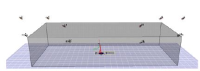


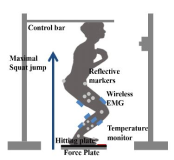
The human foot is only part that directly contact between the body and the external environment, and is ideally positioned to provide sensory information to the Central Nervous System (CNS) during static and dynamic tasks. Through cutaneous mechanoreceptors located in the dermis, the foot is able to recognize touch pressure and vibration stimuli, which provide important feedback information used for the fine coordination of movements. The purpose of this study is to quantitatively examine the effect of changing the foot cutaneous sensory by temperature stimulus on maximal performance and muscle activation using wavelet technique. Sixteen healthy subjects volunteered to participate in this study (Male: Age 21.4±2.4years; Height 174.7±5.3츠; Weight 70.6±5.2kg; Female: Age 20.5±0.6years; Height 163.2±3.1cm; Weight 55.6±4.8kg). Sensory pressure thresholds were determined for the plantar surface of the foot using monofilament. Kinematic, kinetic and EMG data which relative to maximal performance were collected while squat jumping in each temperature condition(cool 12-15℃ normal 28-30℃ hot 45-48℃). Maximal jump height was significant higher in normal condition. Vertical GRF in normal condition showed higher peak value the other conditions. And then EMG signal were significant different between temperature conditions during maximal performance. By changed sensory feedback on temperature, one can alter maximal performance and muscle activation pattern. Cutaneous feedback is important in performance and neuromuscular control, and temperature changes significantly influence on lower extremity during maximal squat jump performance of healthy subjects.


The purpose of this study was to examine the effects of happiness improvement program on psychological variables which were happiness feeling, self-esteem, interpersonal relationship, internal-external locus of control, stress, coping, perceived performance and physiological variables such as cortisol and serotonin of collegiate badminton players. The participants consisted of 10 collegiate badminton players. Happiness improvement program for collegiate badminton players was developed by previous literatures, in-depth-interview, psychological test data, and consultation of happiness improvement experts. The happiness improvement program consisted of 12 intervention program: orientation, rapport development and the understanding happiness, self-esteem enhancement techniques, interpersonal relationship strategies, stress and coping management, peak performance methods, and action plan of happiness improvement program. Each program was applied to participants in about 90-120 minute a session(2-3 times session a week). The instruments of this study were made up of three broad categories: (a) psychological data, b) physiological data, and (c) qualitative data. Firstly, happiness improvement program significantly increased happiness feeling, self-esteem, internal-external locus of control, interpersonal relationship capability, coping skills of collegiate badminton players. Secondly, happiness improvement program significantly decreased stress of collegiate badminton players. Thirdly, participants positively perceived the effects of happiness improvement program on psycho-physiological variables. The limitations of this study and future implications were discussed.
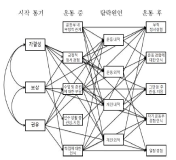
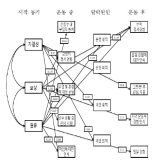
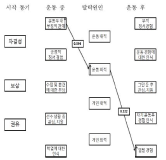
The purpose of this study is to explore the drop-out process of student-athletes and propose valuable policy ideas related to interscholastic sports. For this purpose, we surveyed 560 middle and high school drop-out student athlete's in 13 areas and finally 400 completed surveys were used for the study. To set the scales used for the study and test the reliability and validity of the scales, factor-analyses, Cronbach's alpha, and interfactor correlations were conducted using SPSS. For the main test, the paths analyses were carried out with AMOS program. As a result, we found two paths which had major effects on the drop-out process of student-athletes, self-efficacy path at the point of starting athletic career and negative relation path during athletic experiences. Based on these results, the following policy ideas were proposed. First, student-athletes should be able to join and leave athletic teams voluntarily. Second, the comfortable environments were provided to promote student-athletes' positive emotion toward athletic teams.



KThis study aims to positively analyze relationship between internal communication, involvement, organizational identification, customer orientation, and relation continuity intention of workers at commercial sports center. For this end, we have conducted survey for 195 workers working at 10 commercial sports centers in the metropolitan area. Sampling method was Convenience Sampling Mode, and questionnaire has been structured to be self-administerd type. SPSSWIN Ver. 21.0 and AMOS 18.0 have been used for data processing. As a result, internal communication has positive influence on the organizational identification at first. Second, involvement has positive influence on the organizational identification as well. Third, organizational identification has positive influence on the customer orientation. Fourth, customer orientation has positive influence on the relation continuity intention. Fifth, internal communication has no positive influence on the relation continuity intention. Sixth, involvement has no positive influence on the relation continuity intention.
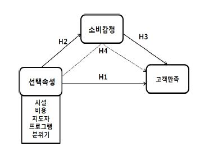
The purpose of the study was to provide managers and owners of fitness center with new marketing strategies for distinction strategies of quite competitive Korean fitness industry with analysis of mediating effects of consumption emotion within the relationship of fitness selection attribute and customer satisfaction. This paper chose fitness center customers as population of this study who registered in each 5 fitness centers in Seoul and Gyeonggi using convenience sampling. For this study, 400 questionnaires were given fitness center customer. For the analysis of data, 376 questionnaires were used using SPSS 15.0 Windows and Amos 7.0. To examine respondents demographics traits, frequency analysis was processed and reliability analysis, confirmatory factor analysis and correlation analysis for relationship among the variables were conducted. For the verification of model suitability and research hypotheses, the mediating effects were tested by using Bootrapping method and Aroian-test through structure equation modeling. The significance level was set at α=.05, and the results are as follows. First, Among fitness selection attribute variables, structural strategy, cost, a trainer and program had significant influence on customer satisfaction, but, atmosphere and facilities had not significant on customer satisfaction. Second, Among fitness selection attribute variables, structural strategy, cost, a trainer and atmosphere had significant influence on consumption emotion, but, facilities and program had not significant on consumption emotion. Third, consumption emotion had significant influence on customer satisfaction. Fourth, consumption emotion fully mediated in the relationship between fitness selection attribute and customer satisfaction.

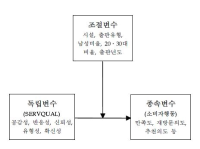
The current study aimed to investigate the impact of SERVQUAL on sport consumer behaviors using meta-analytic techniques. Findings from 25 dissertations and 26 journal articles were used to test of a model of the SERVQUAL on various sport consumer behaviors via the comprehensive meta analysis (CMA) program. Results showed that SERVQUAL has a large effect on sport consumer behaviors, with a fixed effect size of .383. In terms of the relative importance of the SERVQUAL sub-factors, sport consumer behaviors were influenced most by empathy, followed by reliability and tangibles. In predicting sport consumer behaviors, SERVQUAL had a most positive effect on, in order of, loyalty, customer orientation, and commitment. Results also found significant moderating evidence for sport facility types, publication types, publication year, the ratio of male and respondents' age.
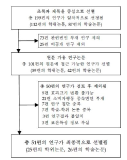


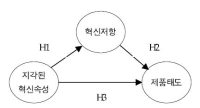
The Purpose of this study was to examines the effect of smart sport wear's innovation attribute on product attribute, focused on innovation resistance. Data were drawn from 253 college students and graduate college students in three different university. The model was tested using SPSS/PC ver. 18.0 for windows and AMOS 20.0 program. Data were analyzed using frequency analysis, reliability analysis, confirmatory factor analysis, correlation, and structural equation modeling techniques. The statistical significance level was set at a<.05. The results were as follows. First, perceived attributes of smart sport wear had a negative effect on innovation resistance. Second, innovation resistance had a negative effect on product attribute. Third, perceived attributes of smart sport wear had a positive effect on product attribute. Forth, innovation resistance partially mediated the relationship between perceived attributes of smart sport wear and product attribute.


