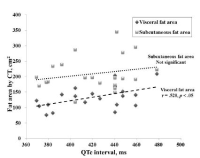
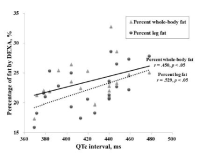
The purpose of this study was to examine the relationship between QTc interval and maximal oxygen consumption(V˙O2max) and body fat distribution in middle-aged men. Abnormal subjects (QTc interval, ≥440ms, n=10) and normal subjects(≤430ms, n=11) using QTc interval based on the Bazzet's equation were involved in the study. After overnight fasting, blood and blood pressure were measured. Abdominal fat area and regional fat compartment were measured by computed tomography(CT) and dual-energy X-ray absorptiometry(DXA), respectively. For V˙O2max, the subjects underwent a maximal graded exercise test on a cycling ergometer. Abnormal group was significantly higher in SBP, basal insulin, HOMA-IR, and leg fat compared with normal. There was a significant relationship(r=.614, p=.03) between QTc interval and V˙O2max in all subjects. Also, partial correlation analysis showed a significant relationship(r=.480, p=.032) between the QTc interval and V˙O2max. Having a QTc interval outside normal range significantly worsened risk parameters for metabolic syndrome, in particular blood pressure and insulin resistance. Moreover, QTc interval was strongly correlated with cardiorespiratory fitness in middle-aged men. This study indicates that further study will be needed to assess the exercise training effects on QTc interval.

The purpose of the study was to determine relationship of abdominal fat, adipocytokine, bone mineral density, and bone turnover markers in obese male adolescents. Twenty four male adolescents (obese: 12, normal: 12) volunteered to participate in the study. Anthropometry and skeletal maturity were measured. Body composition and bone mineral density were estimated by DXA (Hologic, QDR-4500, USA). Abdominal fat with total adipose tissue (TAT), visceral adipose tissue (VAT), subcutaneous adipose tissue (SAT), and visceral adipose tissue to subcutaneous adipose tissue ratio (VSR) were estimated by computed tomography (ECLOS, HITACH, Japan). Blood samples were obtained for and analysis of adipocytokines including leptin and adiponectin. Bone turnover markers, osteocalcin (OC), bone-specific alkaline phosphatase (BALP) for bone formation markers and N-terminal telopeptide (NTx), C-terminal telopeptide (CTx) for bone resorption markers were analysed. All data were analyzed utilizing SAS 9.3 (SAS Institute, NC, USA). Independent t-test was used to evaluate the differences between obese adolescents and normal adolescents. Pearson correlation analysis was applied to figure out the relationship between abdominal fat, adipocytokines, bone mineral density, and bone turnover markers. Multiple regression analysis was used to find out the factors of abdominal fat which influence on bone mineral density. A level of significance was set at p<.05. The results of the study indicated that fat tissue (p<.001), percent body fat (p<0.001), TAT (p<.001), VAT (p<.001), and SAT (p<0.001) were significantly higher in obese adolescents than normal adolescents. However bone mineral contents were significantly higher in normal adolescents. Normal adolescents have significantly higher whole body BMD and lumber BMD than obese adolescents. Abdominal fat including VAT and SAT related negatively with whole body BMD and lumbar BMD. Leptin related negatively with BMD whereas adiponectin related positively with BMD. NTx for bone resorption marker related positively with abdominal fat. Visceral adipose tissue was a predictor for whole body BMD and lumbar BMD in explaining 46% and 32% in adolescents. In conclusion, obese male adolescents have lower whole body BMD and lumbar BMD than normal adolescents. Abdominal fat including VAT and SAT related negatively with whole body BMD and Lumbar BMD. And leptin and adiponectin were closely related with BMD. Finally, visceral adipose tissue was a predictor for whole body and lumbar BMD in adolescents.
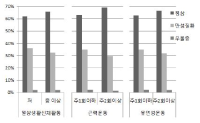
This study examined the association between physical activity (PA) and the prevalence of chronic disease and chronic depression. Additionally, the relationships between PA and health-related quality of life (HRQoL) among general population, categorized by healthy, chronic disease and depression were investigated. Cross-sectional data includes 9,739 participants (4,351 males, 5,659 females, over 19 years old) who completed physical activity, chronic disease and HRQoL questionnaires from The Fifth Korea National Health and Nutrition Examination Survey (KNHANES). Complex samples frequency, descriptive, cross-tab and logistic analysis were used. Estimated prevalence of chronic disease and depression were significantly different between PA levels and frequency. Based on odds ratios (OR) and 95% confidence intervals (CI), participating in lower levels of daily PA including less resistance and flexibility exercise were associated with an increased likelihood of chronic disease. Less frequency of resistance PA was also associated with an increased likelihood of depression. Estimated prevalence of HRQoL was different according to PA in the healthy and chronic disease populations. Adjusted OR and confidence intervals represented through lower levels of daily PA and less frequency of resistance PA were associated with an increased likelihood of poor HRQoL in the chronic disease population. No significant OR between PA and HRQoL in the depression population was observed.
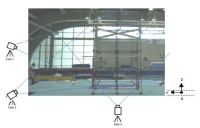
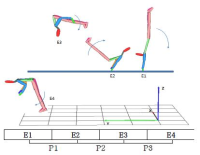
The purpose of this study was to identify the characteristics through technical analysis of dismount to perform the successful landing. The subjects in this study were male gymnastic players of the national team, hish-speed cameras were used to record the salto backward dismount on the parallel bars of the subjects and to study the qualitative and quantitative analysis. The evaluations including feedback of each subjects’problem were as follow: KHH showed early release timing compared to other players. It could be one of factors which can not decelerating the rotational speed, so the correction of posture is needed. NYI didn’t slide to the left at the release phase, and showed big rotation of body compared to other players so the center of mass moved to the rear. The correction of the hand position at flight phase is necessary to perform the V-shaped position. RSD landed in a state where the rotation is insufficient, so the training using elasticity of parallel bars at phase 2, and the correction of hand position are in need. PMS’s rotation angular velocity of body increased consistently, so showed instable land. Therefore the training to ensure the height of flight is required. PEJ showed high vertical position of CM at the release phase which is help for height of flight. He performed ideal V-shaped position, and took a relatively stable landing position. BGR also showed high vertical position of CM and performed ideal V-shaped position, so he landed in a posture in which the most stable. YHS should push vertically rather than horizontally at the moment of release. Especially, the hand position is not on the hamstring but on the back of the knee to perform the ideal V-shaped position. CJY showed little hip angle at the release phase, so he can’t take a position for vertical rise. Also he showed the lowest knee angle and performed rotation and landing in a state that cannot extend the knee. If such problems are corrected, it will be helpful to landing position not only in parallel bars but also in other events.
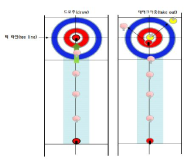
In this paper, we tried to find out the difference of CoM displacement, CoM velocity and Foot-pressure between draw motion and takeout motion in curling’s delivery motion. To do this, we experimented for 10 female athletes of curling national team(all athletes are in her 20th~30th ages) to carry out draw motion and takeout motion from backline to near hogline in state of speed limit. The limited speed was 3.80~3.90 sec for draw and 2.97~3.07 sec for takeout. From the experiments, we obtained the result like followings. 1. Draw motion is more increase than takeout motion in displacement of horizontal direction of CoM displacement. 2. Takeout motion is more increase than draw motion in displacement of vertical direction of CoM displacement. 3. Takeout motion is faster than draw motion in both of horizontal and vertical direction of CoM max. velocity. 4. Takeout motion is higher than draw motion in pressure of fore-foot and mid-foot of foot-pressure 5. Draw motion is higher than takeout motion in pressure of fore-foot and mid-foot of foot-pressure These result means that the characteristics of techniques for draw motion and takeout motion is differ from each other and it is necessary to take different training protocol individually to enhance athletes’s performance. And further research will contains another things like that the pursuit of curling stone’s rut by various delivery techniques



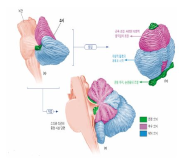
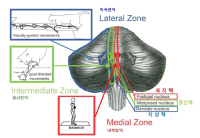
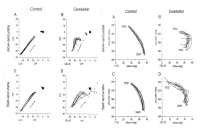
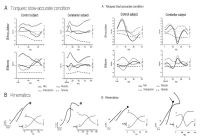
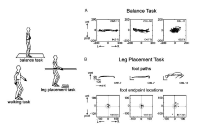
The cerebellum is one of the major parts of the brain involved in the motor control including motor coordination, muscle tone, balance, and the learning of motor skills. The purpose of this review paper was to explore of pathophysiology, anatomical function and neurophysiological mechanism for cerebellum. For this, we sought to examine of previous study related cerebellar disease. Specifically, this paper suggested that motor deficiency of limb movements, coordination, gait/posture balance, adaptation of during movement execution through information proprioception or kinaesthesia, and motor planning and programming of cerebellar patients. We expect that this review will be able to offer the useful information to research. For example, movement scientists will provide an academic information about cerebellar ataxia. Patients and their families will provide relevant information to the daily life (e.g., management and rehabilitation exercise).



Purpose: The purpose of the present study was to identify the difference of overall putting accuracy and/or distance control among three visual conditions; executing putt focusing vision on the near target(ball), focusing on the far target(hole), and with no vision. In order to satisfy ecological validity, the test was held not on the synthetic putting green in a laboratory, but on the outdoor real putting green. Methods: A putting green with slight slope and minimal break was selected as the test site. The test was held at 8.5m uphill, 13m uphill, 8.5m downhill, and 13m downhill. Twenty participants were asked to putt the ball as close to the target as possible. They were also asked to adhere to their own pre-putt routine having enough time of visual fixation toward the hole to get distance and direction cues. Each Participant putted a total of 12 balls putting 3 balls on each distance-slope experimental condition. Overall putting accuracy score represented actual distance (in meter) from the far target(hole) to the ball rest. Distance control score represented it from the near target(original ball position) to the ball rest. Repeated measure ANOVA was used to verify the raw data. Results: Putt from 8.5m uphill and putt from 13m downhill were revealed to have statistically significant difference only in distance control by visual focus conditions. Putt focusing vision on the ball was the best at 8.5m uphill. Putt focusing vision on the hole was the best at 13m downhill. However, there was no significant difference in overall putting accuracy by visual conditions. Discussion & Conclusion: The results of our study are interesting and valuable from two aspects. First, the presumption is that overall putting accuracy on the real putting green has no significant difference by visual conditions because it is affected by various factors, i.e. memory of distance, slope, break, turf condition, impact quality, body alignment, etc. Second, no consistent evidence was detected that specific visual condition, especially executing putt focusing vision on the hole, was the best for distance control.

With coming industrial convergence era, there are the necessity of industrial convergence in sport industry. Therefore, the purpose of this study is to provide classification system and trend. This study applied case study method with semi-constructed interview, integrative literature review and observation. In addition, this study provide the conceptual framework for the classification system in sport industry related to industrial convergence. To conclusion, among the several criteria related to industrial convergence for product-new technology criterion, there are virtual sports, diagnosis valuation solution and exercise guide solution for participant sport market. In the case of new technology-service criterion, there are new media and virtual broadcasting for spectator sport market, and u-learning for participant sport market. For product-service criterion, there are complexity of sports facility and sportainment for spectator sport market, and virtual gaming sports and participatory tour for spectator and participant sport market. In addition, the trend of the sport industrial convergence has changed from leading media industry to converging with diverse industry areas.
Many teams in the first division soccer league in Korea are suffering from financial insolvency which has resulted from lack of fan support. Despite the mentioned fact, many teams are still distributing free tickets which results lessoned ticket sales revenue. In order to address the fundamental issue of financial insolvency, it is important to seduce more paid fans to come to stadiums along with increased number of fans. The current study, therefore, examined the perceived value of K-league match ticket prices compared with other competitors such as baseball, basketball, and movie theaters. Data were collected from Gyeongnam F.C.'s home game and out of 164 data collected, 127 were utilized for further analysis. A conjoint analysis was conducted using regression analysis (Luce, 1959) to compare fans' perceived value of ticket prices among different entertainment options. The results displayed that K-league teams should consider increasing ticket prices as it is currently under-priced and, as a result, higher ticket price will drive increase in revenue.

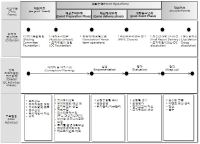
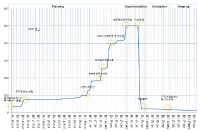
The purpose of the study was to define the chronical aspect of the sport event and suggest timeline concepts include the work scope of the sport event organization. For accomplish the research goal, literature review on time frame of sport event and the in-depth interview(n=23) was fulfilled. The results of this study were as follows; 1) the time based concept and the perception of the point of phase transition is different in each functional area, 2) the sport event time-frame could be categorized in ex ante Event stage, Event operation stage and ex post Event stage as general and the Event operation stage was departmentalized in preparation phase, Game delivery phase and closure phase. As a result, this study suggested the transition criterion in each phase. Limitations and future directions for real time sport event organization were discussed.