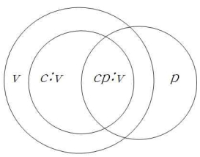
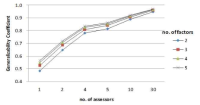
The purpose of this study which is follow up study of Lee and Kim(2015b)'s was to analyse error sources and estimation of reliability in peer review of forced connection method-sportscasting by applying generalizability theory. Generalizability theory quantify error sources of the data measured under certain specific situation set by the researchers. It is an analysis method that the relative influences of each error sources taking from score is determined(G-study), and the effective measurement condition future applicable is provided(D-study). Participants were 10th high school students(N=216). Data were collected from student's peer review results and analyzed using univariate and multivariate generalizability theory. Results showed that error source for video have a more significant impact than other error sources. But the result by analyzing the gender difference was that error source for the interaction of video and participants have a more significant impact than other error source in the case of girls. Peer review used in this study showed high generalizability coefficient and even when reducing the number of video or participants it can maintain the adequate reliability. But generalizability coefficient of boys was higher than girls and specific measurement conditions leading to enhanced reliability were different when analyzing by gender difference. Also, method of analysis which cannot reflect measurement conditions properly estimates the reliability excessive. Discussions were provided in term of the relative influences of each error sources, the effective measurement condition maintaining the Generalizability coefficient of a certain level, and the comparison the Generalizability coefficient with the way of estimation traditional reliability applying univariate and multivariate Generalizability theory taking from score in peer review of forced connection method-sportscasting.


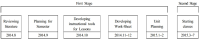
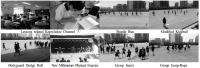
Researchers and teachers in physical education have emphasized sportsmenship in sport education setting. However, how to teach sportsmenship in physical education is not proposed yet. The purpose of this study was (1) to develop an instructional program for teaching and learning sportsmanship and (2) to examine its effects on sportsmenship. Participants were 7th middle school students(N=95). Data were collected using Sportsmanship Test(Park, 2014), open-ended questionnaire and in-depth interviews with students. The data were analyzed through paired samples t-test and qualitative content analysis. Results showed that significant difference was observed in students' sportsmanship test scores after instruction. Analysis of interview data showed that students experience the value of utmost effort, respect for opponents, respect for teammates, acknowledging results, respect for judgment, and valuable lessons related to character education. Implications for sportsmanship education using instructional program were discussed.
The purpose of this study was to describe the epidemiology of Korean collegiate injuries during 2015. Collegiate student-athletes(n=167) in six sports (badminton, baseball, basketball, rugby, taekwondo, and volleyball) participating in all practices and games during pre-season, in-season, and post-season were tracked via the injury surveillance system(rate, location, type, and cause of musculoskeletal injury). Injury rate for 1000 athlete-exposure(AE) and 1000 time-exposure(TE) were calculated with 95% confidence intervals(CI). We captured a total of 961 injuries, a rate of 19.29/1000 AE(95% CI=18.07, 20.51) and 0.16/1000 TE(95% CI=0.15, 0.17). Commonly injured body locations were knee(17.5%, n=168), thigh(16.1%, n=155), ankle(12.1%, n=116), and finger(8.4%, n=81). Injuries were mostly diagnosed as contusion(40.1%, n=385), ligament sprain(21.1%, n=203), and laceration/abrasion/skin injury(13.5%, n=130). Common causes were contact with another athlete(44.6%, n=429), contact with moving object (12.7%, n=122), overuse/atraumatic(11.9%, n=114), and contact with non-yielding object(9.4%, n=90).

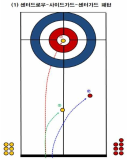
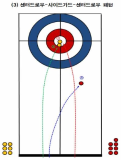
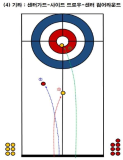
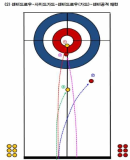
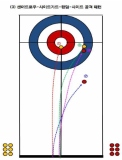
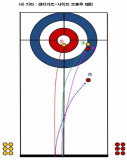
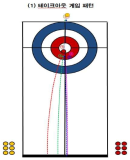
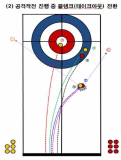
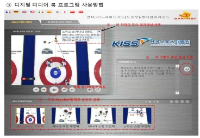
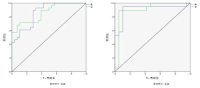
This study has analyzed 33 domestic games and 26 overseas games by targeting women curling teams of home and abroad, and looked into what main performance variables are, how level differences of domestic team appear, and from which variables differences between winning team and defeated team come out in overseas teams. Also, main strategies has been suggested that are used most commonly for kick-off offense and latter offense, blank strategy in order to prepare countermeasures, and digital media DB has been constructed that can utilize proper countermeasures easily and simply, and a model has been proposed for predicting victory/defeat. To accomplish such goal, a variance analysis has been carried out by dividing domestic teams into each level after calculating frequency and ratio with SPSS18.0, and t-test analysis has been carried out by overseas teams. Also, the accuracy of victory/defeat classifications has been suggested by using an artificial neural networks method. As a result, a lot of technical proficiency differences have appeared among Class A(upper rank), Class B(middle rank), and Class C(lower rank) in domestic teams. The ‘Guard’ which is an aggressive variable has turned out to be used more in upper and middle teams than in lower team, and the ‘Tab Back’ has been used more in upper rank than in lower rank. Furthermore, regarding the average comparison on victory/defeat in international games, victory teams have more significant difference(p<.05) than defeated teams in accuracy of shot techniques and strategy accomplishing abilities, and victory teams have been turned out to use less ‘Drew’ and more ‘Take’ than defeated teams significantly in Drew and Take’ technique variable. Finally, the accuracy of a prediction model has been 91.7% for learning and 92.9% for the test result to predict the victory/defeat in international games through the artificial neutral network analysis. The prediction accuracy of domestic games was 81.0% for learning and 71.4% for the test.




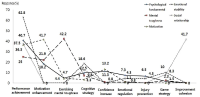
This study aimed to explore the psychological factors affecting sports performance and their purposes as perceived by adolescent athletes. Study data were collected by conducting an open-ended survey with 232 student athletes from adolescent athletes in S city. The collected data were categorized using content analysis, which was conducted twice to explore the psychological factors affecting sports performance and their purposes. From 537 answers, 30 performance-affecting psychological factors—including confidence, endurance, effort/dedication, optimal tension, and social support—were identified, and they were classified into five categories: psychological fundamental, mental toughness, motivation, emotional stability, and social relationships. From 588 answers, the purposes of the psychological factors were identified, including performance achievement, motivation enhancement, demonstrating mental toughness, cognitive strategy, confidence increase, emotional regulation, injury prevention, game strategy, and reinforcement cohesion. These performance-affecting psychological factors and their purposes may serve as a reference to understand how secondary school students perceive the relationships among various psychological factors and the relationship between the psychological factors and performance. This study is expected to inform goal setting and content organization in psychological skills training.
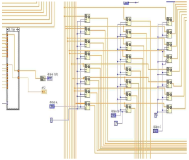
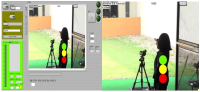
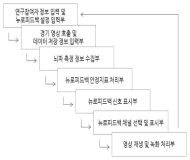
This study was to develop and to apply real-time neurofeedback system for psychological self-regulation of shooters. Neurofeedback system was developed with expert meetings consisting of 8 sport psychology, EEG, and sport engineering experts based on Labview program. Developed neurofeedback system was applied to 4 college shooters for 10 sessions(1 session/week, 30 mins/session). Collected EEG wave data were analyzed by paired sample t-test and independent sample t-test. The results were as follows: Firstly, based on user experience concept neurofeedback system was developed which easily perceived neurofeedback information as traffic lights with minimizing visual search activities. Secondly, after neurofeedback system application right brain activation level of shooters(except one shooter) were increased compared to left brain activation. Based on the results of this study, neurofeedback system can apply various sports and contribute to help athletes’ self-regulation and athletic performance enhancement in sport field.

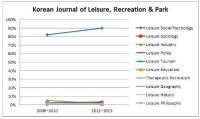
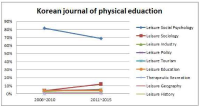
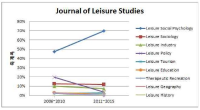
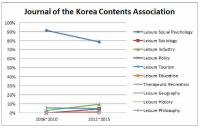
This study identified the trends in leisure and recreation research in Korea for the past 10 years. We classified previous research based on ten leisure and recreation research areas and compared the research trends of five journals: Korean Journal of Leisure, Recreation & Park, Korean Journal of Physical Education, Journal of Sport and Leisure Studies, Journal of Leisure Studies, and Journal of the Korea Contents Association. The results indicated that most research published over the last decade were included in the area of leisure social psychology, and the area of leisure social psychology showed the highest ratio in five journals compared with other research areas. To resolve the problematic results, this research suggests that future research needs to have diversity to extend the leisure and recreation research realm and to improve the quality of leisure and recreation research in Korea. We expect that this study would be used as a foundation for future leisure and recreation research.

The primary purpose of the study was to compare cardiovascular function, mental health indices, stress-related variables according to body mass index (BMI) and percent body fat (%BF) in 20s females. Sixty-eight women, aged 20-29 yrs, participated in the study as subjects. There were three groups, i.e., normal group (BMI<24 kg·m-2 and %BF<25%; n=25), normal weight obese group (BMI<24 kg·m-2 and 28%<%BF<40%; n=19), and obese group (BMI>26 kg·m-2 and 28%<%BF<40%; n=24). Cardiovascular function, mental health indices, stress-related blood variables were measured and compared among three groups. Main results of the present study were as follows: 1) SBP, DBP, mean arterial pressure, and RPP were significantly higher in obese group than normal group. 2) There were no significant differences in mental health indices among three groups. 3) Fasting plasma insulin, fasting plasma glucose, and CRP were significantly higher in obese group than normal weight obese group and normal group. It was concluded that there would be abnormal cardiovascular function, insulin resistance, and inflammation in general obese individuals in 20s females, not normal weight obese and normal individuals.

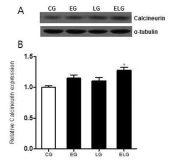
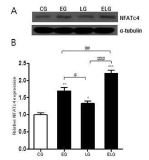
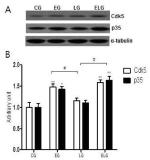
It has been reported that continuous exercise and bright light exposure improved resistance to stress and reduced depression and anxiety, which were attributed to enhancing neurotransmitter GABA exocytosis and stimulating neurogenesis. In this study, the effects of treadmill exercise and bright light exposure on the expression of GABAAreceptor activity, calcineurin and calcineurin calcium signaling pathway-depended NFATc4, neurogenesis-related protein Cdk5 and specific regulator factor of Cdk in neurogenesis p35 in the hippocampus of rats were investigated by western blot assay. The expression of GABAAreceptor, Cdk5 and p35 significantly increased in the exercise+light group compared to the control group and the light group. The expression of KCC2 and NFATc4 significantly increased in the exercise+light group compared to all the other groups. And the expression of calcineurin significantly increased in the exercise+light group compared to the control group. The overall results showed that exercise and bright light stimulated neurogenesis of the hippocampus in rats and had positive effects on improving the brain neuronal function.

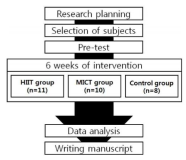
The primary purpose of this study was to investigate the effects of 6 weeks of high-intensity intermittent training (HIIT) and moderate-intensity continuous training (MICT) under relatively equal energy expenditure on body composition, aerobic capacity, cardiovascular function, insulin resistance, and blood lipid profiles in 20s overweight males. Twenty-nine males were randomized into one of the following groups: HIIT group (n=11), MICT group (n=10), and control group(n=8). Subjects in HIIT group completed 6 weeks of training for 25 min/sessions, three times/wk, and subjects in MICT group exercised for 33 min/session to equalize the energy expenditure with HIIT group. Subjects in control group were asked to maintain their normal life pattern during the same intervention period. Data were analyzed using two-way repeated measures ANOVA with post hoc test. Main results of the present study were as follows: 1) Body weight, BMI, fat mass, and WHR decreased significantly in HIIT group. 2) VO2max, VEmax, and time to exhaustion increased significantly in HIT group. 3) SBP decreased significantly in HIIT group and HRrest was tended to decrease in HIIT. 4) Fasting plasma insulin and HOMA-IR were tended to decrease in HIIT, but the changes failed to reach the statistically significant level. 5) HDL-C and TG were tended to improve in HIIT, but the changes failed to reach the statistically significant level. Results indicate that high intensity intermittent exercise training is more beneficial in aerobic capacity and cardiovascular function. It was also suggested that 6 weeks of aerobic exercise training in either high intensity intermittent or moderate intensity continuous was not sufficient enough to induce changes in body composition, insulin resistance and blood lipid profiles.
