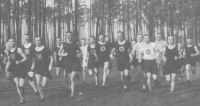
PURPOSE This study examined the process and cause of change in nationalism in German gymnastics in the 19th century. METHODS The study used a literature study method and analyzed data from previous studies. Eleven articles related to the research topic were chosen for domestic research data by searching RISS for "German gymnastics," "Turnen," and "German nationalism." Overseas research data involved seven articles related to this study and were found by searching for "German gymnastics" and "Turnen" in Google Scholar. RESULTS First, German nationalism was originally divided into liberal nationalism and nationalistic nationalism, resulting in nationalistic nationalism after German reunification. Second, Jahn as a liberal nationalist and Spiess as a nationalist attempted to spread their ideas through German gymnastics. Finally, German gymnastics change from Jahn's liberal nationalism to Spiess' nationalistic nationalism was inevitable due to German gymnastics' external background and inherent limitations. CONCLUSIONS This study illustrated the process and cause of the change in the nationalistic characteristics of German gymnastics in the 19th century. Various historical cases that have not yet received attention but are worthy of investigation must be studied.
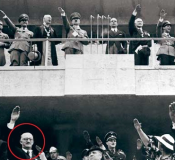
The research is to shed new light to historical meaning and value of Carl Diem who was a pillar of modern sports in Germany and also served as an athlete, PE administrator, journalist, sports scholar and dean of a university. He has been highly regarded in Korea as a trail-blazer of German sports, but in his own country, he who once served as the secretary general of the 1936 German Olympics was at the center of controversy since he was named as a pro-Nazi, and even the name of a place named after him was deleted. Having said that, as an athlete, he played a huge role in organizing sports clubs where he worked as an chairman; organized and held various sports competition events; laid the academic groundwork for the modern sports in Germany by majoring in Sports in the United States. Above all, he is the one who came up with the torch relay and staved to define the significance of the Olympic Games by founding the International Olympic Academy. His academic and practical capabilities were proven through the establishment of Deutsche Sporthochschule Köln, also known as German Sport University Cologne. And Carl Diem Research Institute is still up and running to this day. Thus, in this research, I’d like to take a look at his passion for sports and changes of German sports including the German Olympics and offer a multi-faceted view on him who was evaluated during a historical turmoil back then.
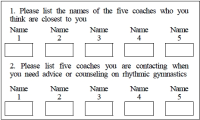
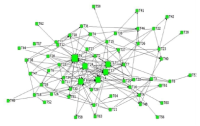
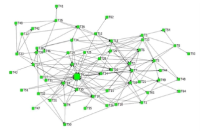
Previous work has shown that coaches sought information from several sources; however, there was a strong reliance on learning from other coaches within their social networks. There has been limited research examining the nature of these social networks with other coaches (Trudel and Gilbert 2004). Thus the purpose of this study was to examine the structures of coaches’ social networks of Korean rhythmic gymnasts. Research questions were: (1) What are the network structures of Korean rhythmic gymnasts’ coaches? (2) What structural parameters contribute to coaches’ network structures, and (3) Is there an association between coaches’ network and flow of information in their networks? A total of 37 coaches of youth rhythmic gymnasts (6-18 years old) participated in this study. Each of those coaches was asked to complete a Name Generator Questionnaire (i.e., list four names that you have a close relationship with) and general socio-demographic survey. Data were analyzed using social network analysis tools such as UCINET, p-net, and Quadratic Assignment Procedure. Analysis of network centrality, density, and strong components showed that (1) homophily was identified in the structure of coaches’ social networks (2) homophily (e.g., by gymnasts’ ranking, mentor coaches) contributed to the total social network of coaches, and (3) interacting only with close coaches in the network, coaches received information about coaches/coaching from the strong ties rather than weak ties (Granovetter, 1973). This study also has strong links to Wenger’s (1998) community of practice which posited that groups of people share a common characteristic in practice.
Purpose The purpose of this study is to examine the elite sport system in Germany by selecting six keyword. Methods In order to review the literature, we reviewed the reports of sports organizations such as the Ministry of the Interior, the Olympic Games of Germany, the Sports Council of Germany, and the German sports policy, history, business, programs and financial status. Conclusion In Germany, athletic associations were created in the 40s and 50s and strengthened infrastructure, projects, and workforce infrastructure by the 60s and 90s. Through its long history and tradition, Germany is at the forefront of both the Winter and Sommer Olympics. Among them, the German Olympic Sports Federation, researchers Institute, Olympic training centers, Sports School, Kader-systems and federal police·military·customs are the main keyword of elite sports. In order to support the national players in Germany, the regional Olympic training center supports sports science, sports gymnasium, sports athletic high school, sports elite school, athletes' house are operated for selection and training of excellent athletes. And all the players are in the carder system and there is a system that allows them to enter the federal police, soldiers and customs so that they can support the human resources, facilities and programs as well as train and work at the same time.

Purpose The purpose of this study is to calculate the ranking of vault players in artistic gymnastics by individual and by country using the PageRank algorithm. The purpose of this study is to provide basic data that can be used in gymnastics events by comparing the performances of historical vault players with those of previous Olympic competitions. Methods The data collected for this purpose is a score of 117 vault players based on the results of the Olympic final event published in the International Gymnastics Federation (FIG). For data analysis, PegeRnak algorithm was used for calculating the ranking of vault players using MS-Excel and NetMiner. Results The results are as follows that. First, the PageRank algorithm is possible to calculate for historical vault players' rankings. Specifically, the ranking of vault players for historical Olympic calculated by PageRank ranked as Gervasio Deferr from Spain (ESP) at 1st, Alexei Nemov from Russia (RUS) at 2nd, and Klaus Koste from Germany (GDR) at 3rd. Second, Network of vault players' ranking is separated by each generation of Olympic games. Conclusions As a conclusions, it is possible to calculate national ranking of vault games of gymnastics by using PageRank algorithm.


Purpose The purpose of this study was (1) to analyze judges’ evaluation on rhythmic gymnastics performance by applying generalizability theory and (2) to suggest recommendations to improve judges' rating. Methods Data were 34 players’ scores from Senior Part at 29th KGA President’s Cup National Rhythmic Gymnastics Championship in Korea. Difficulty and execution scores in ball, clubs, hoop and ribbon event were analyzed. Analysis models containing components of area and reputation rank were designed and multivariate generalizability theory were used for analysis. Results The G-study results showed (1) that the error source about players has more significant impact to evaluation than other error sources in analysis model containing components of only player and judge, (2) that the error source about players has more significant impact to evaluation than other error sources in analysis model adding components of area, but the error source about area has more significant impact to evaluation of clubs event than other error sources, (3) that the error source about players has more significant impact to evaluation than other error sources in analysis model adding components of reputation rank, but the error source about reputation rank has more significant impact to evaluation of hoop event than other error sources in analysis model adding components of area. The D-study results showed generalizability coefficient was stable in analysis model without components of area and reputation rank, but generalizability coefficient in analysis model containing components of area and reputation rank not stable in some event. Conclusion Recommendations for improving judging were discussed.

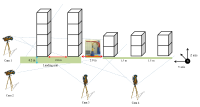
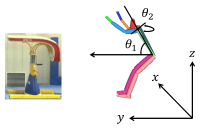
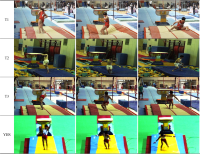
Purpose The purpose of the study was to perform a comparative analysis of the YANG Hak Seon technique carried out by "K" athlete with the kinematical data of "Y" athlete and propose a method to improve the YANG Hak Seon technique of "K" athlete. Method The subject recruited for the study was a male athlete from Korean national team (Age: 21, height: 1.65 m, body weight: 59.6 kg, and career: 11 years). Four high - speed cameras were used to analyze the 3D motion of the YANG Hak Seon technique performed by "K" athlete. The variables selected for analysis were the velocity of COM, displacement of COM, the rotational & torsional angle of the trunk and rotational & torsional angular velocity of the trunk. The results obtained were compared to the preexisting data of the "Y" athlete (data set from the published research). Results Firstly, the horizontal displacement of the YANG Hak Seon technique of the "K" athlete was observed to be shorter along with lower vertical displacement during landing compared to “Y” athlete. In addition, the overall horizontal velocity was low and vertical velocity was not generated which rises during the BC (board contact) phase. Although the rotational angular velocity of the trunk was lower during the BC, HC (horse contact) phase and LD (landing) phase, torsional angular velocity was higher during the LD. Conclusion In order to improve the completeness of the YANG Hak Seon technique of the K player, it is necessary to enter with a fast and low posture on the footplate during the initial phase. In the BC phase, it is essential to raise the COM simultaneously while landing on the footplate and increase the rotational angular velocity of the trunk.
PURPOSE Taekwon gymnastics is expected to be a program that can overcome the management difficulties currently faced by Taekwondo gyms and contribute to the expansion of Taekwondo base. Therefore, this study aimed to examine the relationship among organizational identification, flow experience, intention to continue participation, and recommendation intention of Taekwon gymnastics participants. METHODS In this study, data was collected from 313 teenagers participating in Taekwon gymnastics at Taekwondo gyms in the metropolitan area from September 10 to 24, 2021. A total of 267 questionnaires were selected as the final sample, and data analysis was conducted using SPSS 23.0 and AMOS 23.0. RESULTS Organizational identification had a significant effect on flow experience, challenge only had a positive effect on intention to continue participation, flow experience did not significantly affect recommendation intention, and intention to continue participation had a significant effect on recommendation intention. CONCLUSIONS The results of this study confirmed that organizational identification can contribute to improving inner pleasure and self-esteem, and it is necessary to examine the role of factors that can mediate the relationship between flow experience and behavioral intention in the future. Furthermore, managers of Taekwondo gyms should hold various events that can inspire teenagers’ sense of challenge to encourage intention to continue participation.
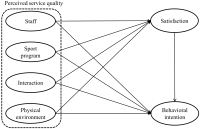
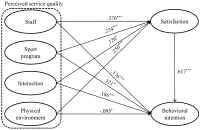
Purpose This study aimed to investigate the impact of perceived service quality on satisfaction, and behavioral intention in migrant members of German sport clubs. Methods The questionnaire was structured in four sections: perceived service quality (four dimensions and 12 items), satisfaction (two items), and behavioral intention (two items). With data from 438 members of 33 sport clubs in western Germany, SPSS 23.0 and AMOS 23.0 were utilized to conduct factor analysis, reliability, validity, and structural equation modeling analysis. Results The results of this study indicated that (1) staff, sport program, interaction, and physical environment in perceived service quality had a significantly influence on satisfaction, (2) staff, sport program, and interaction significantly affected behavioral intention, and (3) satisfaction was found to have significantly impact on behavioral intention. Conclusions The delivery of high-quality services can promote satisfaction, which in turn lead to behavioral intention. The empirical results suggest that the practitioners and sport club mangers should understand the importance of perceived service quality for the retention of members in sport clubs.

Purpose The purpose of this study was to explore the optimal model for winning medal on vault event of men's gymnastics. Specifically, decision tree analysis was used to explore, first, for the optimal conditions for qualifying top 8th player that have high possibility into final round, and second, for the optimal model for obtaining the medal of the vault event. Methods Data were collected for five official competitions (Olympics, Asian games, and International championship, etc.) organized by the Federation of International Gymnastics (FIG) from 2013 to 2016. In this study, the data of 626 vault players were collected. Also all of these players performed 921 vault skills for qualifying round or final round. Five predictor variables for estimating for qualifying into the final round and for obtaining the medal of the vault event were selected; nationality, difficulty score, acting score, additional penalty score, final score. Results The results is as follows. Overall, it was confirmed that the optimal model for entering into the final round was the difficulty score of vault event. The optimal model for entering into the final round estimates 81.2% when condition would be the 5.6 or higher of difficulty score and 8.6 or higher of the acting score. The optimal model for winning medals was 86.7%, which means that when condition would be the 6.0 or higher of difficulty score and no additional penalty score. Conclusions This models can be used as a basic data for establishing a strategy for medal acquisition of vault event of gymnastics.