Purpose : The purpose of this study was to investigate coaching information with which coaches provided players during badminton competition. Methods : To this end, we generated an open-ended questions and presented it to 88 high school athletes registered in the Badminton Korea Association. The survey was conducted during a tournament and immediately after the tournament to collect the data. The collected data were categorized through inductive content analysis. Results : As a result of this study, a total of 480 raw data points collected through the open-ended survey were categorized into four general areas: psychological information, technical information, tactical information, and game operation information. Specifically, psychological information was divided into six subdivisions: concentration, confidence, relaxation/stabilization, mental toughness, play thought, and passion; technical information was broken into four subdivisions: strokes, footwork, swing and posture, and position preparation; tactical information had four subdivisions: coping to opponents, play changes, rotation, and manipulation of opponents; and, game operation information was divided into two subdivisions: taking the lead in a game and changing atmosphere. Conclusions : In other words, in badminton competition, the coaches strengthened psychological skills that promote psychological stability to attain the athletes’ peak performance and modified the athletes’ motion into the action necessary for achieving accurate techniques. Furthermore, they provided a variety of coaching information so that the athletes will respond appropriately to their opponents’ play, take the lead in games and induce a positive mood. The psychological, technical, tactical and game operation information offered by badminton coaches are the main factors influencing the performance of badminton players and suggest a need for the proper management and control of the coaches as well as athletes for the peak performance.
The purpose of this study was to conduct an in-depth exploration of Korean national badminton players’ psychological momentum strategies. Data were collected using an open-ended questionnaire and group interviews of 66 badminton players, including 40 members of the 2018 Korean national badminton team and 22 college and semi-pro badminton players who each had badminton careers of 10 or more years and were registered in the Badminton Korea Association. The data were analyzed using inductive content analysis and the deductive process based on the inductively categorized results. The results are as follows. First, regarding strategies for maintaining positive momentum, 188 raw data were collected and classified into three category (keeping pace, dominating the play, and psychological facilitation) and 10 sub-category (including speedy resumption of the game, attacking weak points, and fighting shout). The results suggest that badminton players maintain positive momentum by using strategies to control the speed and tempo of the game at their preferred pace, implement special techniques, exploit their opponent’s weaknesses, and cheer or talk amongst themselves to motivate each other and communicate with their partners and coaches. Second, regarding strategies for overcoming negative momentum, 293 raw data points were collected and classified into three category (time outs, psychological reminders, and changes in plays) and 11 sub-category (including delaying the game, seeking social support, and play change). The data demonstrate that badminton players overcome negative momentum using strategies to intentionally delay the game and exchange equipment, focus on performance cues, and interact with their coaches and partners to change plays and prevent errors. It is hoped that these study findings will inform efforts to provide psychological support that is effective in increasing the odds of winning for the national badminton players in the Asian Games and the Olympic.
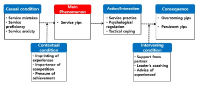
Purpose This study aims to investigate the experience of service yips in badminton players in depth through using grounded theory method. Methods We collected data from in-depth interviews with 14 participants in total, consisting of badminton players who experienced service yips, their doubles partners and coaches. The collected raw data were analyzed base on derive transcription, coding and paradigm models through grounded theory method. Results First, as a result, 59 concepts, 31 subcategories and 15 categories in regard to badminton service yips were deduced from open coding. Second, in axial coding, it was structured in a paradigm model by categories such as service yips, service mistakes, service proficiency, service anxiety, the imprinting experiences, the importance competition, the pressure of achievement, service practice, psychological control, tactical handling, support from partners, leaders’ coaching, advice from experienced ones, overcoming yips and persistent yips. Third, selective coding resulted in ‘Badminton service yips’ as the core category of this study. ‘Badminton service yips’ is a chronic performance impairment associated with badminton players making severe errors in swing motion on a service not intended by them that it is due to physiological or psychological symptoms such as hand tremors, overall body stiffness, arms stiffness, overstress, overanxiety, and concern over service mistakes. Conclusions We expect our study can be a theoretical foundation for understanding and explanation of ‘Badminton service yips’ and a useful reference for badminton players suffering from psychological difficulties caused by their service yips. The findings in this study should be considered for the development of potential strategies for overcoming the badminton service yips.
Values, such as development and social responsibilities, are added on victory-oriented Korean sport. Those change of values are along with discussions regarding improvement of players’ training environment, however, discussions on improvement of players’ training environment so far rather focused on ideological concepts, such as players’ holistic human development and human rights, therefore, there was a lack of discussion on practical training methods or teaching methods. This study focused on mental coaching as a specific method for improvement of players’ training environment. Mental coaching provides players with performance enhancement, personal growth, and self-actualization utilizing mental training, consulting, and mentoring in their training processes. This study examined a possibility of introduction of mental coaching as a training camp method for players by creating a training camp reflected on mental coaching perspectives and verifying the program effects of application. First of all, a mental coaching training camp was created through consultations with mental coaches, supervisors, and coaches. Goals of the mental coaching training camp were development of competition-routines, establishment of competition-circumstance coping strategies, comprehension of elite-players’ psychological resources, goal-setting, and motivation and the program consist of badminton competitions, mental education, a special lecture by an Olympic gold medalist, tracking, and sharing. The mental coaching training camp proceeded with middle and highschool badminton players and 31 coaches during three-days and four-nights. As results, the training camp was effective for players’ performance enhancement, personal growth, and self-actualization and team coaches realized a necessity of improvement in terms of their training and teaching behaviors. In other words, mental coaching training camp played a role as a source of long-term change as well as short-term results, thus, this study verified that the mental coaching can be introduced as a training camp method. It is anticipated that this study can provide sport fields and academic sport areas with an opportunity to consider both training contents and methods when it comes to discussion players’ training environment development.
The purpose of this study was to examine psychological capital acquisition through Asian Games Participation. 17 of national women football players were completed Psychological Capitals Questionnair. The psychological capital consists of optimism, psychological skills, self-management, collective efficacy, and performance perception was investigated after the team call-ups and before the team-release. The data was analyzed by paired t-test. As results, Korean women football players’ collective efficient and performance perception showed a statistical significance at the beginning of the team call-ups but optimism, psychological skills, and self-direction did not show statistic significances. The team-harmony, interpersonal-management, team-power, sufficient training, trust in coach, efficient communication, and psychological football factors, which were subfactor of football players’ psychological capital, showed statistical significances. However, confidence, concentration, goal-setting, imagery, willpower, anxiety-control, mental-management, life-management, training-management, innate-behavior management, physical-management, football skills, mediative skills, and football intelligence factors did not have statistic significances. These results demonstrate that effects of mega sporting events-like experiences and psychological factors’ variability and inflexibility according to weather changes should be considered when it comes to discussion of psychological factors regarding players’ performance. It is expected that this study would be a fundamental resource for understanding of psychological influences through participations in mega sporting events and discussions about further psychological interventions for teams with environmental consideration as well as methodological developments which could measure effects of the psychological interventions.
This study conducted to explore K-League (Korea Professional Football League) referees’ psychological experience and coping strategies just after the moment of wrong judgment. Open-ended questionnaire were conducted on 35 full-time referees who participated in the K-League winter training camp. The data were categorized by inductive content analysis. The results were as follows. Psychological experience yielded 45 raw data points, which were based on the following 10 sub categories; increased anxiety, rumination wrong judgment, concern about reprimand, and feeling apologetic; and four general categories including, psychological fragmentation, feeling helpless, concern about reputation, and acknowledgment of wrong judgment. Thus, K-league referees experience a psychological turbulence just after the moment of the bad calls and worsen feelings of helplessness about the wrong decisions. Also, K-league referees worry about further disadvantages following the misjudgement and admit their bad calls feeling sorry for teams and athletes who were in the incidents. Coping strategies yielded 55 raw data points from which the following categories were identified 11 sub categories; increasing concentration, attempting to forget wrong judgment, apologizing on wrong judgment, and change in thinking; and four general categories including, emotional self-support, avoiding situation, correcting the error and thinking, and changing of refereeing approach. Therefore, K-league referees enhance their concentration in order to not reoccur wrong judgement after the moment of the mistakes and try to forget the incidents of wrong judgement. Also, K-league referees apology to the teams and athletes who experienced the bad calls and make efforts to correct the mistakes if possible. Moreover, K-league referees try to modify a criteria of judgement in order to manage aftereffects of wrong judgement and make decisions correctly by approaching the scenes of the wrong judgement. The study emphasizes the importance of referee psychological stability on the field and the need for psychological support. The study is expected to encourage further research on sports referees in Korea to ensure they receive appropriate psychological support.
