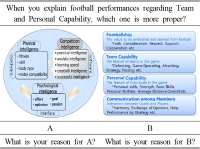
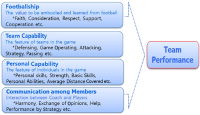
Purpose The following study was conducted to suggest and verify the validity of the concept of team performance, which has previously been considered as the total sum of individual performances. Method The concept of team performance was extracted by a conductive content analysis and an exploratory factor analysis of the data gathered from middle school football players. To verify the validity of the extracted concept, football experts' opinions were collected. Results The idea of team performance, categorized by Footballship, Team Capability, Personal Capability, Communication among Members, has been taken differently from the total sum of individual performances. Footballship is the virtue that should be materialized, and simultaneously earned during the game. Team Capability is a available resource for team's performance, Personal Capability is a available resource for a player's performance, and Communication among Members is the intimacy of communication between coaches and players. The conglomeration of experts' opinions on the concept of team performance and its components shows that team performance is evidently different from the total sum of individual performances. Conclusion The following study has been conducted to suggest and verify the validity of the concept of team performance. Team performance exists, standing distinct from the sum of individual performance, and understanding the concept of team performance will contribute not only to understanding performance, but also to improve the effectiveness of training and managing the team. Interest of the sport society is looked forward to.
The purpose of this study was to examine psychological capital acquisition through Asian Games Participation. 17 of national women football players were completed Psychological Capitals Questionnair. The psychological capital consists of optimism, psychological skills, self-management, collective efficacy, and performance perception was investigated after the team call-ups and before the team-release. The data was analyzed by paired t-test. As results, Korean women football players’ collective efficient and performance perception showed a statistical significance at the beginning of the team call-ups but optimism, psychological skills, and self-direction did not show statistic significances. The team-harmony, interpersonal-management, team-power, sufficient training, trust in coach, efficient communication, and psychological football factors, which were subfactor of football players’ psychological capital, showed statistical significances. However, confidence, concentration, goal-setting, imagery, willpower, anxiety-control, mental-management, life-management, training-management, innate-behavior management, physical-management, football skills, mediative skills, and football intelligence factors did not have statistic significances. These results demonstrate that effects of mega sporting events-like experiences and psychological factors’ variability and inflexibility according to weather changes should be considered when it comes to discussion of psychological factors regarding players’ performance. It is expected that this study would be a fundamental resource for understanding of psychological influences through participations in mega sporting events and discussions about further psychological interventions for teams with environmental consideration as well as methodological developments which could measure effects of the psychological interventions.
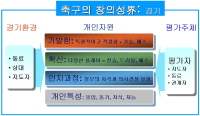
The purpose of this study was to explore a framework of understanding football performance. Researcher review was conducted to organize perspectives for football performance and drew implications as well as drift of football performance based on intelligence approach. Discussions for intelligence had been proceeded in concepts of learning ability, multiple intelligence, successful intelligence, and moral intelligence. Discussions of football performance approaches fitness, skill, and strategies in traditional intelligence aspects. The multiple intelligence perception discusses perspective, mentality, body, and analysis. The successful intelligence perspective deals with creativity, practical intelligence, and football talents. However, specific discussions for moral intelligence have not been progressed yet. FIFA’s social responsibility project and UEFA’s RESPECT campaign reflect that the discussions of football performance develops in a way of the moral intelligence. In European football, issues regarding value, such as RESPECT and against Racism, are currently emerging. Considering the change in the European football, the global football leagues will share the issues related to value in the near future. Given the fact that discussion for intelligence had been proceeded learning ability, multiple intelligence, successful intelligence, and moral intelligence, the moral intelligence will be a main concern in the further football performance discussion. The moral intelligence will be incorporated into football performance evaluations soon. Furthermore, teams and players will strive to place efforts in order for pursuing value and reputation as factors of performance.



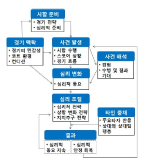
This study was purposed to explore psychological change and regulation process during badminton competition. The data were conducted using group interviews and participation observations who 18 K college badminton players. The data were analyzed using open, axial, and selective coding based on grounded theory method (Strauss & Corbin, 1998). The results were as follows: Open coding results, 89 concepts, 44 subcategories, and 18 categories emerged as psychological change and regulation process during badminton competitions. Axial coding results, the categories are showed structural relationships such as performance, score, psychological momentum, the importance of competition, court environment, physical condition, competition strategy, psychological preparation, past experience, outcome expectation, psychological disturbance, psychological skills, game situation-changing strategy, support-seeking strategy, significant others' behavior, the opponents' behavior, psychological resilience, and maintenance psychological disturbance. Selective coding results, core category of this study was revealed to maintain psychological homeostasis. Environmental context during badminton competitions causes specific situations and events that evoke psychological disturbance. In turn, a player seeks mental and behavioral strategies to maintain psychological homeostasis. There is psychological homeostasis mechanism during badminton competitions for peak performance. Development of proper interest for psychological homeostasis will be improved through this research approach in sport psychology.

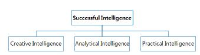
This study was to analyze the hierarchical importance of successful intelligence in Football coaches and players. In order to explore the hierarchical importance of successful intelligence 24 football coaches(under AFC A course) and 20 Korea Football Association U15 Players were responded to analytic hierarchy process questionnaires. In the Analytic Hierarchy Process, football coaches and players completed the AHP Questionnaire with creative intelligence, analytical intelligence and practical intelligence. The hierarchical importance order of successful intelligence for coach and player were analytical intelligence, practical intelligence, and creative intelligence respectively. Evaluation of hierarchical importance of successful intelligence for coach is analytical intelligence(.542), practical intelligence(.278), creative intelligence(.181) in order. Evaluation of hierarchical importance of successful intelligence for coach was analytical intelligence(.684), practical intelligence(.161), creative intelligence(.155) in order. The hierarchical importance of successful intelligence for coach and player were similar each other. Analytical intelligence, was evaluated most important factor for coach and player in successful intelligence. Successful intelligence is important issue for sport performance. More consider needs to Successful intelligence for sport psychology researchers.



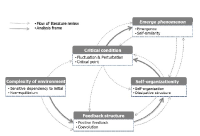
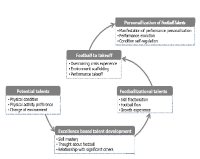
Purpose This study was aimed at interpreting the football talent development stages based on complexity theory. Methods The data for this study was gathered through literature review and in-depth interviews that were analyzed by thematic analysis. Literature review of the studies regarding complexity theory revealed the features of complexity theory and five football players participating in the K-league were interviewed. Gathered materials were analyzed by the thematic analysis. Initial codes and potential themes of football talent development stages, the conception and potential themes of the complexity theory were interpreted by metaphorical analysis. Results Results of literature review were as follows: analysis frame of complexity theory were organized environment of complexity, feedback structure, self-organization, critical condition and emergent phenomenon. The football talent development stages, interpreted as a result of literature review, were divided into Potential Talents, Excellence based Talents Development, Footballizational Talents, Football to Takeoff and Personalization of Football Talents. The stages were specifically materialized as follows: Potential Talents was materialized into physical condition, physical activity preference and change of environment. Excellence based Talent Development was materialized into skill mastery, thoughts about football and relationship with significant others. Footballizational Talents was materilized into skill fractionation, football flow and growth experience. Football to Takeoff was materialized into overcoming crisis experience, performance scaffolding and performance takeoff. Personalization of Football Talents was materialized into manifestation of performance personalization, performance evolution, condition maintenance. Conclusion Football talent development stages, interpreted by means of complexity theory, were divided into Potential Talents stage, Excellence based Talent Development stage, Footballizational Talents stage, Football to Takeoff stage and Personalization of Football Talents stage. Utilization of this study as a fundamental resource of football talents development programs and as a means to understanding football talents development is looked forward to.
The purpose of this study was to conduct an in-depth exploration of Korean national badminton players’ psychological momentum strategies. Data were collected using an open-ended questionnaire and group interviews of 66 badminton players, including 40 members of the 2018 Korean national badminton team and 22 college and semi-pro badminton players who each had badminton careers of 10 or more years and were registered in the Badminton Korea Association. The data were analyzed using inductive content analysis and the deductive process based on the inductively categorized results. The results are as follows. First, regarding strategies for maintaining positive momentum, 188 raw data were collected and classified into three category (keeping pace, dominating the play, and psychological facilitation) and 10 sub-category (including speedy resumption of the game, attacking weak points, and fighting shout). The results suggest that badminton players maintain positive momentum by using strategies to control the speed and tempo of the game at their preferred pace, implement special techniques, exploit their opponent’s weaknesses, and cheer or talk amongst themselves to motivate each other and communicate with their partners and coaches. Second, regarding strategies for overcoming negative momentum, 293 raw data points were collected and classified into three category (time outs, psychological reminders, and changes in plays) and 11 sub-category (including delaying the game, seeking social support, and play change). The data demonstrate that badminton players overcome negative momentum using strategies to intentionally delay the game and exchange equipment, focus on performance cues, and interact with their coaches and partners to change plays and prevent errors. It is hoped that these study findings will inform efforts to provide psychological support that is effective in increasing the odds of winning for the national badminton players in the Asian Games and the Olympic.
This study conducted to explore K-League (Korea Professional Football League) referees’ psychological experience and coping strategies just after the moment of wrong judgment. Open-ended questionnaire were conducted on 35 full-time referees who participated in the K-League winter training camp. The data were categorized by inductive content analysis. The results were as follows. Psychological experience yielded 45 raw data points, which were based on the following 10 sub categories; increased anxiety, rumination wrong judgment, concern about reprimand, and feeling apologetic; and four general categories including, psychological fragmentation, feeling helpless, concern about reputation, and acknowledgment of wrong judgment. Thus, K-league referees experience a psychological turbulence just after the moment of the bad calls and worsen feelings of helplessness about the wrong decisions. Also, K-league referees worry about further disadvantages following the misjudgement and admit their bad calls feeling sorry for teams and athletes who were in the incidents. Coping strategies yielded 55 raw data points from which the following categories were identified 11 sub categories; increasing concentration, attempting to forget wrong judgment, apologizing on wrong judgment, and change in thinking; and four general categories including, emotional self-support, avoiding situation, correcting the error and thinking, and changing of refereeing approach. Therefore, K-league referees enhance their concentration in order to not reoccur wrong judgement after the moment of the mistakes and try to forget the incidents of wrong judgement. Also, K-league referees apology to the teams and athletes who experienced the bad calls and make efforts to correct the mistakes if possible. Moreover, K-league referees try to modify a criteria of judgement in order to manage aftereffects of wrong judgement and make decisions correctly by approaching the scenes of the wrong judgement. The study emphasizes the importance of referee psychological stability on the field and the need for psychological support. The study is expected to encourage further research on sports referees in Korea to ensure they receive appropriate psychological support.
Values, such as development and social responsibilities, are added on victory-oriented Korean sport. Those change of values are along with discussions regarding improvement of players’ training environment, however, discussions on improvement of players’ training environment so far rather focused on ideological concepts, such as players’ holistic human development and human rights, therefore, there was a lack of discussion on practical training methods or teaching methods. This study focused on mental coaching as a specific method for improvement of players’ training environment. Mental coaching provides players with performance enhancement, personal growth, and self-actualization utilizing mental training, consulting, and mentoring in their training processes. This study examined a possibility of introduction of mental coaching as a training camp method for players by creating a training camp reflected on mental coaching perspectives and verifying the program effects of application. First of all, a mental coaching training camp was created through consultations with mental coaches, supervisors, and coaches. Goals of the mental coaching training camp were development of competition-routines, establishment of competition-circumstance coping strategies, comprehension of elite-players’ psychological resources, goal-setting, and motivation and the program consist of badminton competitions, mental education, a special lecture by an Olympic gold medalist, tracking, and sharing. The mental coaching training camp proceeded with middle and highschool badminton players and 31 coaches during three-days and four-nights. As results, the training camp was effective for players’ performance enhancement, personal growth, and self-actualization and team coaches realized a necessity of improvement in terms of their training and teaching behaviors. In other words, mental coaching training camp played a role as a source of long-term change as well as short-term results, thus, this study verified that the mental coaching can be introduced as a training camp method. It is anticipated that this study can provide sport fields and academic sport areas with an opportunity to consider both training contents and methods when it comes to discussion players’ training environment development.

PURPOSE This study explored psychological experiences in long jump competitions and examined the continuity of psychological experiences over time. METHODS A total of 28 adult long jumpers, 18 men and 10 women, were provided data through in-depth interviews. Data on psychological experiences were extraced through inductive content analysis, while continuity by period was analyzed by calculating the response frequency ratio using Excel. RESULTS First, the psychological experience in the long jump competition was categorized as fundamental, competition intelligence, emotional control, and communication capacity experience. Second, in long jump competitions, results showed that jumpers experienced mixed feelings of anxiety and pressure, self-confidence, and concentration in the first period; peer communication and analysis thinking were necessary in the second period; practical intelligence and pressure control were important in the third period; learning ability and creativity were crucial in the fourth period; learning ability and coach communication were applied in the fifth period; and fighting spirit and creativity were present in the sixth period. Third, the psychological experience of long jumpers by period, basicphysical strength was maintained; competition intelligence increased in the second and fourth periods; communication skills increased until the fifth period, and decreased after; while emotional control decreased. This reflects the contextual changes over time andthe change in competition records owing to that. CONCLUSIONS In the long jump competition, psychological experience changes by period and affects competition records. This study will contribute to further understanding of psychological continuity.
