
Purpose The purpose of this study was to examine the relationship between performance factors and physical fitness in secondary school female biathlon athletes. Participants in this study were 14 female biathlon athletes. Methods All factors such as aerobic capacity(VO2max, %AT), wingate test(peak power, average power, fatigue index), isokinetic test(trunk, knee, hip, ankle), 1RM test(leg press, chest press, lat pull down), physical fitness(grip, knee and back muscle strength, sit & reach, power, agility) were tested. In order to analyze collected data, pearson product moment and multiple regression analysis were utilized. The results were summarized as follows : First, there was a significant correlation between aerobic. Results The results were summarized as follows : First, there was a significant correlation between aerobic capacity and three factors(standing broad jump, isokinetic test 60° right knee extension)(p<.01). There was a significant correlation between wingate test and four factors(isokinetic test 30° left ankle ever, 30° right ankle ever, 120° left ankle inver, leg press)(p<.10). Conclusion These results suggested new evidence that ankle strength is necessary for performance in female biathlon athletes.
The purpose of this study was to examine the relationship of obesity index, fitness and cardiovascular risk index in middle and high school students. Obesity index, fitness score and cardiovascular risk index were measured from 1,044 middle and high school students. The results of relation between obesity index and fitness showed that the higher obesity index had significantly lower fitness score for both boys and girls (boys: p<0.001, girl: p<0.05) The results of relation between obesity index and cardiovascular risk index indicated that the higher obesity index had significantly higher cardiovascular risk index for both boys and girls (boys: p<0.001, girl: p<0.001). Moreover, The lower fitness index showed significantly higher cardiovascular risk index regardless of gender in middle school students (boys: p<0.001, girl: p<0.01). Therefore, the results of this study indicated that obese adolescents had the lower fitness level and high possibility of cardiovascular risk.
This study was to identify the perception on retirement for professional soccer players as a basic study for the development of career transition program, Professional soccer K-League(K-League Classic, K-League Challenge), N-League(Club League), K3-League(Challenger League) league players registered in 2013 were selected as a population. Structured questionnaire surveys were utilized for the research, total of 1000 questionnaires(250 per league) were distributed and gathered. Final sample of 548 questionnaires were analyzed excluding people which do not respond properly. SPSS was used to identify the characteristics of the responder in frequency analysis. One-way ANOVA was used to find the difference in retiring causes among the leagues, Pearson Correlation analysis was used to examine the correlations among the variables. Multiple regression analysis was used to find the effect of economic and psychological preparation on plans after retirement. The results were as follows. First, among the causes of retirement, 'contract suspended', 'seek other life', 'family issues such as marriage' showed the difference in perception of retirement according to the leagues. Second, psychological preparation was more focused than economic preparation to prepare for retirement planning among players, respectively.

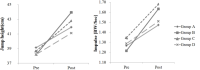
The purpose of this study was to find which percentage of 1RM for squat to improve the result of squat jump most effectively after plyometric training with different percentage of 1RM for squat. 24 men in their twenties were measured 1RM for squat and separated in 4 groups by 6 participants. Group A, B, C, and D used 0, 15, 30, and 45% of 1RM, respectively in the plyometric training. All groups had 1 hour training 3 days per week for 8 weeks(24 sessions). This study designed to increase the number of sets of exercises gradually. In week 1 and 2, participants trained 1 set of plyometrics with no load. The number of sets increased 2 to 4 in the week 3-4 to 7-8. The jump height(cm) and vertical impulse(%BW) of squat jump before and after plyometric training were measured by 3D motion capture system and force plate. All 4 groups showed the improvement of squat jump height and vertical impulse, but specially group B was most improved(p<0.5).

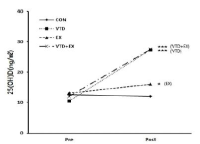
The objective of this study was to investigate the effects of 12-weeks of vitamin D supplementation and circuit training on skeletal muscle mass in elderly women with type 2 diabetes mellitus and vitamin D deficiency. Forty eight elderly women with type-2 diabetes mellitus and vitamin D deficiency were randomly assigned to control(n=10), vitamin D supplement(n=11), exercise(n=12), and vitamin D supplement+exercise(n=15) groups. Dependent variables were measured before and after the 12-week interventions. Major outcomes included body composition, fasting glucose, insulin, and 25(OH)D concentration. ASM(apeendicular skeletal muscle mass), SMI(skeletal muscle mass), and HOMA-IR (homeostasis model for insulin resistance) were calculated. Women assigned to the vitamin D supplement consumed 1,200 IU of vitamin D orally per week for 12 weeks. Women assigned to the exercise intervention performed a circuit training at an intensity of 60%~80% of HRmax with a frequency of 3 days per week for 12 weeks. Compared to control group, all groups had significant loss of body weight and increases in serum 25(OH)D after the 12-week intervention. ASM and SMI increased significantly in only vitamin D+exercise group. Regardless of treatments, no significant group differences were found in changed scores of fasting glucose, insulin, and HOMA-IR. In conclusion, vitamin D + exercise would improve the loss of ASM and SMI compared with vitamin D or exercise alone.
Many teams in the first division soccer league in Korea are suffering from financial insolvency which has resulted from lack of fan support. Despite the mentioned fact, many teams are still distributing free tickets which results lessoned ticket sales revenue. In order to address the fundamental issue of financial insolvency, it is important to seduce more paid fans to come to stadiums along with increased number of fans. The current study, therefore, examined the perceived value of K-league match ticket prices compared with other competitors such as baseball, basketball, and movie theaters. Data were collected from Gyeongnam F.C.'s home game and out of 164 data collected, 127 were utilized for further analysis. A conjoint analysis was conducted using regression analysis (Luce, 1959) to compare fans' perceived value of ticket prices among different entertainment options. The results displayed that K-league teams should consider increasing ticket prices as it is currently under-priced and, as a result, higher ticket price will drive increase in revenue.
Purpose This study aims to explore migration factors of Korean male footballers who have moved from South Korea to Southeast Asian countries. Methods Qualitative case study was conducted with 9 footballers, 4 their agents and 2 K-league staffs as the participant. Results As a result, by regarding their migration as involuntary decision, this study could provide academic and practical discussion on sport labor migration. First of all, this study established theoretical framework for involuntary migration of the participants through ‘Push-Pull Theory’ which focuses on demand and supply on the labor force. Second, this study found that a local rule (FA compensation system) of Korean professional football league (K league) and hierarchical collectivist culture contributed to their migration, which has not been reported by previous studies focused on the voluntary migration of mainstream players and it reflected local context of K league. Conclusions In conclusion, this study confirmed that sport labor migration was also considered as social phenomenon and reflected a cross section of a particular society. Through the migration of athletes, we can provide a variety of viewpoint on economic (market) structure, related policy and system in a particular society, and understand migration motives in terms of agency (subculture).

This study aimed to explore the types of traumatic event experienced by Volleyball players and then prepare to take-off the serial process of posttraumatic growth to schematize a causal network by organizing the factors for overcoming adversity. Participants experiences were collected by distributing open-ended questionnaires to 77 professional Women's volleyball players in 2013-2014 and collected data was categorized by inductive content analysis. These results were schematized by the causal network. As a result of the study, according to the trauma were categorized into four general areas: member conflict, competence loss, physical injury, and coach conflict and the emotions relative to the trauma were categorized into four general areas: powerlessness, pressure, dejection, and hostility also coping factors were categorized into three general areas: social support, intervention strategies, and psychological control. Finally, positive growth emerged as psychological leap, performance improvement, psychological maturity, and emotional stability. And as a result of the categorized study, bring about a better understanding to the posttraumatic growth by causal network. Based on the study results, that volleyball players experienced a positive development on themself after overcoming the problem that they had suffered psychological scars from a traumatic event. In doing so, they contributed to the formation of resources that helped them in their positive lives. In this regard, this study expects to provide the players who have been scratched in mind because of the traumatic experience.



PURPOSE The purpose of this study is to explore the effects of the student-athlete and student peer mentoring program as a collegiate class. METHODS The peer mentoring program, conducted at A University in the first semester of the 2023 school year, was evaluated using practical action research (Zuber-Skeritt, 1996). RESULTS In the introduction stage, ‘relative and absolute evaluation’, ‘member ratio’, and ‘definition of professor role’ were categorized as challenge issues. In the progress stage, ‘de-formalized lecture method’, ‘student athlete’s coaching experience’, and ‘student’s experience of football culture’ were discovered as possibilities, while ‘vacancy and absence of mentor-mentee’, ‘limited group activities and limitations of team sports’, and ‘lack of objective evaluation’ required improvement. At the end stage, student-athletes experienced changes in values such as self-identity, football, and human relationships, as well as quantitative and qualitative changes in sports participation. CONCLUSIONS This study confirmed the potential of the peer mentoring program as a collegiate class as well as its practical significance for guaranteeing student-athletes' learning rights and for forming sports culture on collegiate campuses.
PURPOSE This study presents policy implications drawn from a factual survey on the sports services industry in Korea, aiming to understand its current status and provide systematic support for high growth sectors. METHODS The research involved 600 companies across 18 sports service industry sectors, with growth potential assessed using standardized Compound Annual Growth Rate (CAGR) scores based on indicators such as the number of businesses, employees, sales, business productivity, and labor productivity. RESULTS Results revealed that high-growth sectors were more prominent in the Incheon/Gyeonggi regions, while general sectors showed higher proportions in the Seoul area. Satisfaction with government support programs was above average in high-growth sectors, contrasting with lower satisfaction in general sectors, depending on the criteria. Both high-growth and general sectors faced difficulty securing liquid assets, expressing expectations for government financial support, such as expanded loans. CONCLUSIONS Therefore, a policy for achieving regional balance for sports service industries concentrated in the metropolitan area and differentiation in regional sports service industries is necessary. Through a paradigm shift in business support, the competitiveness of the sports services industry can be enhanced, and comprehensive policies for the domestic sports service industry must be formulated.
