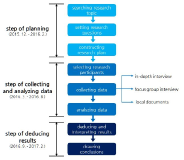
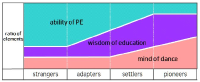
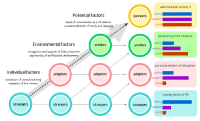
[Purpose] The purpose of this study was to explore the formation process and influential factors of professional identity for the establishment and growth of physical education(PE) teachers majoring in dance. [Methods] Based on the phenomenological research method, data from the interviews, focus group interviews, and local document were collected and analyzed from ten teachers. [Results] First, we explored the process of professional identity formation of PE teachers majoring in dance. It appeared in four stages, 'stranger,' 'adaptation,' 'settler,' and 'pioneer.' Second, we explored the factors of forming the professional identity of the PE teachers majoring in dance. The factors influencing the process of identity formation from the stranger to the adaptation were 'utilization of various training' and 'imitation of their mentor.' The factors influencing the formation process of identity formation from the adaptation to the settler were 'recognition and support of fellow teachers' and ‘opportunity of professional development.’ The factors influencing the process of identity formation from the settler to the pioneer are ‘sense of commitment as a PE teacher,’ ’constant attitude of study and learning.’ [Conclusion] The results suggest that the formation of professional identity of PE teachers majoring in dance goes through a certain stage, and the environment is important as well as the active effort and potential attitude of individual.
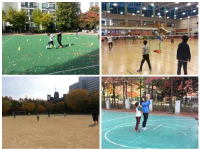
Purpose The purposes of this study were to examine the influence of a formal sports mentoring program on mentors(pre-service PE teachers), and to identify main factors affecting educational growth of the pre-service teachers. Methods Data were generated in this study using: In-depth interviews, mentoring observations, and document resources from 4 mentors and their mentees as research participants. The collected data were inductively analyzed as an iterative process of working back and forth between the data and the categories(Miles & Huberman, 1994). Results The key findings of this study are as follows. First, mentors developed pre-service teachers’ practical knowledge including teaching knowledge, environment knowledge, student knowledge within teaching contexts. Furthermore, they practiced mentee-centered education through sports mentoring not only by mentees but also for mentees. Second, with respect to the factors impacting mentors’ educational growth, there were two main factors; the systematic structure of a program and mentors’ reflexivity. Mentors improved practical knowledge through the circular ‘experiential learning’ phases the sports mentoring program provided. In addition, mentor had valuable opportunities to learn how to care mentees by reflecting on positive and negative influences deriving from interactions with their mentees. Conclusion Potential benefits were embedded in inherent nature of sport and the unique structure of mentoring. sports mentoring can provide experience of learner-friendly teaching distinct from classes of lecture type. It is necessary to be reconsidered as pre-service PE teacher education program with opportunities of other teaching practice.


Purpose Philosophical inquiries into physical education and sport pedagogy(PESP) have not been active until lately. A renewed interested has grown as scholars in UK and European countries have begun philosophical analysis since 2000. This study purports to review the philosophical studies in PESP during the last 50 years, and to forecast the future of SP in Korea based on its strength and weakness. Methods Literature review is adopted as the main method, as the philosophical study requires the conceptual analysis on the ideas. The past research, current main studies and future prospects are analyzed according to the three layers of the professional, the theoretical, and the personal dimensions. Results First, in the professional dimension, the philosophical inquiry by the SP philosophers and the educational inquiry by the sport philosophers are identified. Second, in the theoretical dimension, the exploration on the nature of research in PESP, the suggestions of PE models, the examination of teaching-learning in PE, the promotion of teacher/coach education and professional development, and the analysis of PE curriculum issues and policies are actively produced. Third, in the personal dimension, the practitioner research by PE teacher/professor/coach and the self-study of sport coaches have are begun to be conducted. Conclusions For the prospect of PESP in Korea, it can be said that study in the first dimension would not be bright, where as those of the second and the third would be very good for the near future.
PURPOSE Professional Identity Formation (PIF) has become a core concept in various professional education fields as it emphasizes professionals’ dispositions as well as abilities. This study provides an overview of PIF and explores the characteristics of professional education programs that highlight PIF. Through this overview, the purpose of this study is to propose the ‘Professional Identity Matrix for Physical Education Teacher (PIMPET)’, which helps identify PE teachers’ Professional Identity (PI). METHODS This study suggests a guideline to understand PE teachers' PI based on the analysis of the current literature on PI and PIF. RESULTS The characteristics of PIF-based professional education programs were described according to three criteria: teaching content, method, and assessment. On the PIMPET framework, the components of PI formed by PE teachers can be categorized into nine domains which encompass the three identity dimensions (competence, knowledge, and disposition) and the three task areas (teaching, student, and administration). CONCLUSIONS The PIMPET framework allows for a comprehensive understanding of PE teachers’ PI and provides implications for the professionalism of PE teachers and PE teacher education.
PURPOSE Sport pedagogy (SP) has established itself as a subdiscipline in Human Movement Studies since the 1970s. It has become an academic labyrinth as a result of its rapid flourishing. Most researchers are extremely confused about this disorderly research complex. This study aimed to evaluate the characteristics of SP in stages in the western (mostly English speaking) countries. METHODS Analysis of literature published in English from 1990 to 2022. RESULTS The developmental versions were divided as follows: SP1.0 is positivistic in nature, SP2.0 is multi-paradigmatic as it includes all paradigms, and SP3.0 (current version). Many academic journals have been launched, and a variety of books on divergent topics are being published. Currently, research has exploded. In SP3.0, research performed by British scholars are notable in terms of number and quality, overpowering those by scholars in the USA and other countries. Youth sport and sport coaching are regarded as new legitimate areas. Additionally, signs for SP4.0 have been indicated. CONCLUSIONS In order to find way outs in the SP labyrinth, it is necessary to recognize the current research trends in international SP.
PURPOSE This study aimed to explore the effective and pragmatic idea regarding the development of physical education teacher education (PETE) programs in China. These programs share both similarities and differences in China and Korea, and they are also discussed here. METHODS Six universities reflecting the regional specificities of Korea and China were selected following consultation with experts. Data collected through in-depth interviews, non-participatory observation, literature, and local documents were analyzed and interpreted by using the comparative analysis research method. RESULTS First, when comparing the curriculum, which was divided into liberal arts, major, and teaching subjects in both countries, the ratio of liberal arts and teaching subjects was similar in Korea following major subjects. As for China, major subjects came in first, followed by liberal arts and teaching subjects. Second, the relative pros and cons of preliminary sports teacher education in Korea and China were aimed at nurturing competent sports experts with both expertise and personality. They were generally similar in terms of content dimensions; however, they were found to be different in several areas. Particularly in the case of China regarding the teaching subject, practical subjects that were of pragmatic help to the school field were found to be relatively insufficient. Third, the implications for improving China's preliminary PETE were to emphasize the importance of personality in educational goals at the goal level, and as for the content level, it was necessary to replaced them with classes that could be of pragmatic use in the existing teaching method. Furthermore, at the methodological level, professional training of physical education teachers should be proposed, training them to cultivate character. Finally, more positive changes can be pursued if efforts at the environmental level are well-matched and improved. CONCLUSIONS To improve China's preliminary PETE program, it is necessary to enhance the environment and institutions using various teaching methods to cultivate expertise, such as practical aspects of university-field linkage and preliminary teacher personality education.
