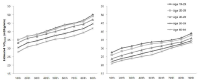
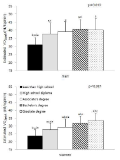
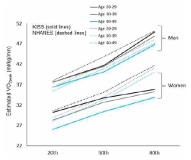
To provide the distribution of cardiorespiratory fitness including Bruce treadmill exercise time and estimated peak oxygen uptake (VO2peak) and investigate association with cardiorespiratory fitness and metabolic syndrome, sedentary lifestyle, or education level among Korean adults. Analysis of data on 2,006 adults (19-64 yr) who had completed a maximal grade treadmill exercise test, from the Sports Institute of Sports Science Fitness Standards (KISS FitS) project 2014-2015. The mean maximal exercise time was 11’26’‘, 11’18’‘, 11’06’‘, 10’03’‘ and 8’51’‘ (minutes and seconds) for men 19-29, 30-39, 40-49, 50-59 and 60-64 years of age, respectively, for women, it was 9’49’‘, 9’09’‘, 8’42’‘, 8’01’‘ and 7’33’‘ for the corresponding age groups. The mean peak oxygen uptake was estimated as 42.3, 41.8, 41.2, 37.6 and 33.6 ml/kg/minute for men 19-29, 30-39, 40-49, 50-59 and 60-64 years of age, respectively, For women, it was 34.0, 31.8, 30.3, 28.0 and 26.4 ml/kg/minute for the corresponding age groups. A positive association between cardiorespiratory fitness level and education level was observed for both men and women. Furthermore, participants with sedentary lifestyle had a significantly lower cardiorespiratory fitness than participants with activity lifestyle. Finally, Men with moderate and high fitness level had 50% and 87% lower odds for the metabolic syndrome, and women had 48% and 50% lower odds for the metabolic syndrome, respectively, than the ones with low fitness level after adjustment for age, smoking, alcohol intake, and sedentary lifestyle. These results can be used to track future Korean assessments and to evaluated interventions. The differences in fitness status by education level, sedentary lifestyle or metabolic syndrome can also be used to develop health policies, program and educational services.

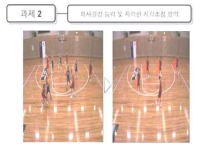
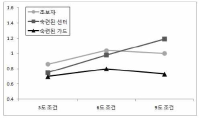
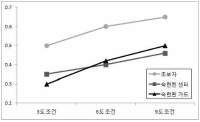
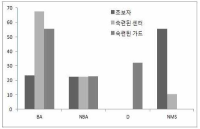
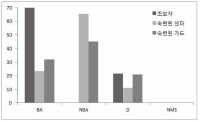
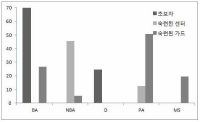
The purpose of this research was to investigate the difference in decision making and perceived eye-focus location on peripheral vision and attacker's expertise in basketball tactical game. A total of twenty four subjects who were expert guard players (n=8), expert basketball center players (n=8), and novices (n=8), participated in this experiment. All subjects participated two tasks. The first task was to anticipate the attack direction after viewing a sequence of basketball tactic film. These films simulated three situations including offensive patterns. The three situations were consist of 3, 6, 9 degree peripheral vision. The second task was to express the level of confidence on their anticipation and to verbalize the perceived visual cues immediately after responding. For this research, an Eyelink eye movement system, an equipment for measuring anticipating, basketball tactic film were used. The variables on anticipation of attack direction were speed, accuracy, and the level of confidence. The acquiring process of advanced visual cues was examined through analyzing visual search strategies and perceived eye-focus location. In order to examine the difference in visual search, in decision making, and in perceived eye-focus locations as a function of expertise, data were analyzed through descriptive statistics, two-way ANOVA, and two-way MANOVA. This research had the following results. First, there was a significant difference on the search rate among the three groups. But, on the other hand, expert guard and center exhibited more fixations of shorter duration than the novices in the 6 and 9 degree condition. Second, results from the ratio of fixation time allotted to areas in the 3 degree condition revealed that experts spent more time fixating the ball-attacker(BA) than novices. The results from the ratio of fixation time allotted to areas in the 6 and 9 degree condition revealed that expert guard and center spent more time fixating the non-ball attacker(NBA) than novices. Expert guard also fixated longer on the pass attacker(PA) and meaning space(MS) than novices. Finally, experts paid attention to two or three locations simultaneously, whereas novices did to only one location such as the ball, attacker, defender, non-meaning space in all condition.



Purpose: The purpose of the present study was to identify the difference of overall putting accuracy and/or distance control among three visual conditions; executing putt focusing vision on the near target(ball), focusing on the far target(hole), and with no vision. In order to satisfy ecological validity, the test was held not on the synthetic putting green in a laboratory, but on the outdoor real putting green. Methods: A putting green with slight slope and minimal break was selected as the test site. The test was held at 8.5m uphill, 13m uphill, 8.5m downhill, and 13m downhill. Twenty participants were asked to putt the ball as close to the target as possible. They were also asked to adhere to their own pre-putt routine having enough time of visual fixation toward the hole to get distance and direction cues. Each Participant putted a total of 12 balls putting 3 balls on each distance-slope experimental condition. Overall putting accuracy score represented actual distance (in meter) from the far target(hole) to the ball rest. Distance control score represented it from the near target(original ball position) to the ball rest. Repeated measure ANOVA was used to verify the raw data. Results: Putt from 8.5m uphill and putt from 13m downhill were revealed to have statistically significant difference only in distance control by visual focus conditions. Putt focusing vision on the ball was the best at 8.5m uphill. Putt focusing vision on the hole was the best at 13m downhill. However, there was no significant difference in overall putting accuracy by visual conditions. Discussion & Conclusion: The results of our study are interesting and valuable from two aspects. First, the presumption is that overall putting accuracy on the real putting green has no significant difference by visual conditions because it is affected by various factors, i.e. memory of distance, slope, break, turf condition, impact quality, body alignment, etc. Second, no consistent evidence was detected that specific visual condition, especially executing putt focusing vision on the hole, was the best for distance control.
PURPOSE This study examined the relations among role modeling, sports confidence, and perfectionism to provide foundational insights into nurturing positive sports confidence in student swimmers. METHODS The survey included a total of 237 middle and high school swimmers registered with organizations under the Korean Sport and Olympic Committee. The analysis included data from 231 participants after excluding 6 insincere responses. The construct validity of the measurement tools was assessed using confirmatory factor analysis, while the basic characteristics of the measured variables and their interrelations were examined using descriptive statistics and correlation analysis. Moderating effects were tested using PROCESS Macro Model 1. RESULTS First, role modeling (r =.274–.471, p <.05) and perfectionistic striving (r =.301–.428, p <.05) showed a positive relation with sports confidence. Second, perfectionistic concern (r =−.056 to −.218, p <.05) was negatively associated with sport-confidence. Third, in the relation between role modeling and sports confidence, the moderating effect of perfectionistic concern was not significant whereas that of perfectionistic striving was statistically significant(ΔR 2=.019, p <.05). CONCLUSIONS Perfectionistic striving may play a positive role in enhancing student swimmers’ sports confidence. Specifically, striving for perfection may facilitate sports confidence improvement among athletes who observe and emulate their role models’ performance and behaviors.
PURPOSE This study aimed to examine the relationship between job stress and occupational identity among taekwondo referees, with particular attention to the mediating roles of job satisfaction and feedback environment. METHODS Participants were 320 referees registered with the Korea Taekwondo Federation or regional Taekwondo associations. Data analysis included frequency analysis, descriptive statistics, confirmatory factor analysis, and reliability analysis. In addition, mediation effects were tested using the SPSS PROCESS Macro. RESULTS The findings revealed that job stress among taekwondo referees had a significant negative effect on job satisfaction and feedback environment. While job satisfaction was positively associated with feedback environment, it did not exert a significant influence on occupational identity. Conversely, feedback environment showed a strong positive effect on occupational identity. Furthermore, both job satisfaction and feedback environment were found to fully mediate the relationship between job stress and occupational identity. CONCLUSIONS Job stress indirectly affects occupational identity of taekwondo referees through job satisfaction and feedback environment. These results highlight the importance of fostering job satisfaction and cultivating a supportive feedback environment as essential mediating factors in mitigating the negative effects of job stress on occupational identity.
PURPOSE This study examines how fitness centers’ care services affect the MZ generation’s perceived value, exercise attitude, and exercise commitment and how perceived value mediates this impact. METHODS Patrons aged 20–30 who used fitness centers in the Seoul and Gyeonggi regions participated in a questionnaire survey from January to February 2024, providing a total of 233 responses. Using SPSS 21.0 and AMOS 21.0, the data underwent frequency analysis, reliability analysis, confirmatory factor analysis, correlation analysis, and structural equation modeling. RESULTS First, perceived caring services had a significant effect on perceived value. Second, perceived value had a substantial influence on exercise attitude. Third, perceived value had no significant effect on exercise commitment. Fourth, exercise attitude significantly drives exercise commitment. Fifth, perceived caring services did not significantly affect exercise attitude or commitment. Sixth, perceived value fully mediates the relation between perceived caring services and exercise attitude. Seventh, perceived value had a full mediating effect on the association between perceived caring services and exercise commitment. Finally, tailored services and emotional support were identified as key factors in fostering MZ individuals’ positive exercise experiences and commitment. CONCLUSIONS Fitness centers should develop strategic services reflecting their customers’ goals and values to enhance their exercise attitudes and commitment and ultimately secure long-term customer loyalty.
PURPOSE This study aims to verify the reliability of a newly developed augmented reality (AR)-based agility measurement method by comparing its outcomes with those of conventional agility tests. METHODS The participants were 12 middle and high school weightlifting athletes. To assess the reliability between the initial field test and the subsequent AR-based test, a dependent t-test and correlation analysis were conducted for three variables: side-step (count), color catch (count), and color catch (average reaction time). RESULTS First, significant correlations were observed between the field and AR-based measurements for side-step (count), color catch (count), and color catch (reaction time), confirming the reliability of the AR-based method. Second, no significant difference was found between side-step (count) and AR side-step (count) (t = 1.910), indicating consistency between the two methods. Third, a significant difference was found between color catch (count) and AR color catch (count) (t = 4.750), suggesting lower consistency in this variable. Fourth, no significant difference was observed between color catch (average reaction time) and AR color catch (average reaction time) (t = 2.100), and the significant correlation coefficient (.579) further supports their consistency. CONCLUSIONS These results suggest that the newly developed AR-based agility measurement method yields reliable data and has practical applicability for sports performance assessment and training in field settings.
PURPOSE This study reviews the operational status of the four courses that comprise the 'International Referee Development Program' in 2022 and 2023, analyzes participant satisfaction and feedback, and derives policy implications for the program’s future direction from the perspective of its operators. METHODS To achieve the study objectives, a literature review was conducted, survey items were developed, and expert meetings were held. RESULTS The four sub-courses within the 'International Referee Development Program' were analyzed by comparing modifications made between 2022 and 2023, evaluating satisfaction survey results, and identifying operational improvements. From the operators’ perspective, the study emphasized the urgency of conducting a comprehensive review of the scope of sports included in the referee development program, establishing clear evaluation criteria for selecting and monitoring focus areas, enforcing sanctions for dropouts under the current format and maximizing outcomes through long-term support. CONCLUSIONS It is expected that by establishing more macro-level and practical key performance indicators (KPIs) under the guidance of the Ministry of Culture, Sports, and Tourism and the Korea Sports Promotion Organization, the program’s continuity and direction will be maintained, even in the event of changes in responsible personnel.
PURPOSE This study first investigated how different types of sport team logos (emblem vs. mascot) influence consumer behavior through warmth and competence and then examined the moderating effects of consumer characteristics (gender) and contextual cues (perceived competence) on these relationships. METHODS A nationwide sample of adults age 20 was selected using quota random sampling based on gender. A 2 (logo type: emblem vs. mascot) × 2 (gender) × 2 (contextual cue: high competence vs. low competence) experimental design was employed, with participants randomly assigned to each group. Confirmatory factor analysis (CFA) with Mplus 8 was employed to assess the measurement model’s reliability and validity, and hypothesis testing was conducted through structural equation modeling (SEM), measurement invariance tests, and multigroup SEM analysis. RESULTS Findings indicate that anthropomorphized mascot logos, compared to emblem logos, generate more positive attitudes and psychological responses (warmth and competence) to the team. Gender’s moderating effect on the relationship between logo type and consumer perceptions (warmth and competence) was not significant, but contextual cues’ moderating effect was partially significant. CONCLUSIONS This study highlights of perceived warmth and competence’s crucial role in shaping consumer attitudes toward sports teams through logo design. These findings offer meaningful insights for sports teams and marketers to optimize branding strategies and enhance fan engagement.
PURPOSE This study examined Julsil impact on self-management and the moderating effect of achievement goal orientation in adolescent male athletes. METHODS Adolescent male athletes (n=248) registered with the Korean Sports & Olympic Committee participated in a survey. After exclusion of data from seven respondents who provided insincere responses, 241 responses were used for the final analysis. After verification of the measurement tool’s construct validity, technical statistical analysis and correlation analysis were performed. Finally, multiple regression analysis and PROCESS Macro (Model 1) were used to verify the research hypothesis. RESULTS 1) Male adolescent athletes’ Julsil and 2) task goal orientation had significant positive effects on self-management,, but ego goal orientation did not. 3) The moderating effect of task goal orientation on the relationship between Julsil and self-management was significant, but that of ego goal orientation was not. CONCLUSIONS 1) Male adolescent athletes’ Julsil and 2) task goal orientation had significant positive effects on self-management,, but ego goal orientation did not. 3) The moderating effect of task goal orientation on the relationship between Julsil and self-management was significant, but that of ego goal orientation was not.
