Purpose Sport has become a popular platform for corporate social responsibility (CSR) campaigns. Growing numbers of athletes, teams, and organizations are engaging in CSR campaigns to promote awareness and behaviors to support CSR campaigns addressing pressing social issues (e.g., disease prevention, health promotion, etc.). However, much of the previous work has focused on whether such initiatives benefit the organization, but not the community. The present paper provides theoretical explanations on the psychological mechanism that can demonstrate how consumers respond to CSR campaigns initiated by a sport organization. Method In particular, existing literatures in moral psychology and CSR have been reviewed to identify an explanatory mechanism that promote prosocial behavior among sport consumers. Results The present paper posits that moral emotion is a central processing mechanism explaining the link between CSR and socially responsible behaviors in consumers. The paper also provides a theoretical account to explain how moral emotions are evoked in the CSR context and how they can prompt prosocial behaviors. Conclusion This paper adds to the literature by answering the call for the need to understand underlying mechanisms linking CSR with positive social outcomes (cf. Aguinis & Glavas, 2012).
Purpose The study was designed to compare physical fitness, indices of lifestyle disease, and biochemical property of muscle according to sarcopenia and obesity in elderly women. Methods One hundred elderly women were alloted to one of four groups, i.e., sarcopenia+obesity (SO: n=20) group, sarcopenia (S: n=20) group, obesity (O: n=29) group, and normal (N: n=31) group. Criterion for sarcopenia was 'appendicular skeletal muscle mass (ASM)/height2<5.4 kg/㎡', and criterion for obesity was 'percent body fat>35%'. Dependent variables regarding physical fitness, lifestyle disease, and biochemical property of muscle were measured and compared among four groups. Results 1) Regarding daily living fitness, grip strength, upper arm flexion, sit-and-reach, up and go, and VO2max in SO group and S group were significantly lower than N group. Regarding isokinetic function, peak torque and average power in SO group and S group were significantly lower, and relative values to body weight in SO group and O group were significantly lower than N group. 2) Regarding hypertension, resting HR and RPP in SO group and O group were significantly higher than S group and N group. Regarding diabetes mellitus, fasting plasma glucose and HOMA-IR in SO group and O group were significantly higher than S group and N group. Regarding hyperlipidemia, HDL-C in SO group and O group were significantly lower than S group and N group. Regarding atherosclerosis, TC/HDL-C ratio and LDL-C/HDL-C ratio in SO group and O group were significantly higher than S group and N group. 3) Regarding biochemical property of muscle, IL-6 in SO group and O group were significantly higher than S group and N group. Conclusion It was concluded that physical fitness was declined in sarcopenia elderly, and that relative value of isokinetic function, indices of lifestyle disease, and inflammation markers were deteriorated in obesity elderly. Especially, the decline and deterioration of physical fitness and indices of lifestyle disease were even more severe in the elderly who had the both status. Therefore, the efforts should be made to prevent and improve sarcopenia and/or obesity.

Purpose The purpose of this study was to investigate the changes of gait patterns and muscle activations according to dual tasks during stair ascending. Methods Twelve sedentary young male adults(Age: 27.0±1.8 yrs, Weight: 65.8±9.9 kg) without any lower extremity injuries participated in the study. Participants performed stair walking up 7 floors and their ascending motion on each floor was analyzed according to dual tasks. A wireless electromyography (EMG) were attached on the Rectus Femoris(RF), Biceps Femoris(BF), Gastrocnemius(GN), Tibialis Anterior(TA) muscle to calculate integrated EMG(iEMG) and co-contraction index(CI). Chest and left heel accelerometer signal were recorded by wireless accelerometer and those were used to calculate approximate entropy(ApEn) for analyzing gait pattern. All analyses were performed with SPSS 21.0 and for repeated measured ANOVA and Post-hoc was LSD. Results The results of this study indicated that dual task appeared to increase their time, CI and there were a statistically significant difference in most muscle on each floors compared to the non dual tasks. Also, ApEn were a statistically significant difference in only left and right direction than non dual task. Subjects showed more irregular pattern and instability muscle activation response during dual tasks. Conclusion Because there are many dangers often use of stairs in everyday life, in the future, we have to make a lot of efforts to prevent fall.
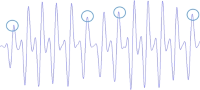

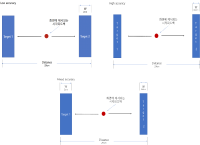
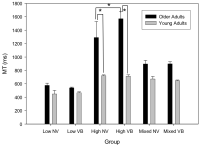
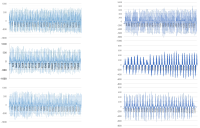
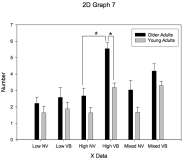
Purpose The present study was to investigate to extent that effects of sensory information distortion by muscle vibration on continuous limb movement in aging and accuracy constraint. Methods Young adult group (n=11) and older adult group (n=11) were divided. All participant were instructed to perform repetitive aiming movement to specified targets under three-accuracy constraints (i.e., low, high, and mixed accuracy constraints) in the vibration and no-vibration conditions. Kinematic data was collected by movement time and movement error frequence. Results The results showed that compared with young adult, older adult increased movement time when accuracy constraint was high under vibration condition. Older adult also was a high degree of movement errors than young adults when accuracy constraint was high under vibration condition. Conclusion The muscle vibration stimulation may influence considerably on the continuous limb movement probably due to degeneration in sensory information processing by aging.
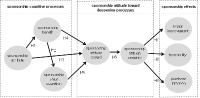
Purpose The purpose of this study was to examine the relationships among sponsorship attributes, sponsorship benefits, recognition of sponsorship value, sponsorship attitude, and sponsorship certainty through structural equation model. Methods Respondents were university students living in Seoul, Kyoungki-do, and choongchung-do. The present study was designed to identify the effect of title sport sponsorship by utilizing NH V-LEAGUE title sponsorship. By using convenience sampling method, total 400 questionnaires were distributed and gathered from samples, and among them 369 valid samples were used for further analyses. The data were recorded and analyzed using the IBM SPSSWIN Ver. 21.0 and AMOS 18.0. 18.0. Results First, sponsorship attributes had a positive influence on sponsorship benefits. Second, sponsorship benefits had a positive influence on sponsorship value recognition. Third, sponsorship attributes had no positive influence on sponsorship attitude. Fourth, sponsorship benefits had a positive influence on sponsorship attitude. Fifth, sponsorship value recognition had a positive influence on sponsorship attitude. Sixth, sponsorship attitude had a positive influence on sponsorship attitude certainty. Seventh, sponsorship certainty had a positive influence on sponsorship effects (image improvement, favorability, purchase intention).
Purpose There is a growing number of potential demand on experiential horse riding tourism due to the expand of tourism and sports industries, however the experiential horse riding clubs are operating inefficiently. Therefore the purpose of this study is to investigate implicity importance of horse riding club’s selection attributes and analyze factors affecting positive effect on market share thereby find the way to improve operating system. Methods The survey was done among 258 horse riding tourism customers of Jeju, Gyeonggi, and Gyeongbuk provinces, and conjoint analysis to figure out the relative importance of selection attributes, and simulation to predict the market share of experiential horse riding were conducted. Results The results are as follows. Cost was the most important factor when selecting horse riding club and program, location, staff were followed by. Also, “The club that serves various activities with horse riding program at 10,000won where the condition of road and parking lot are good” had the best market share. Conclusion This study suggested the effective and efficient manners to operate the horse riding club and the political implication.
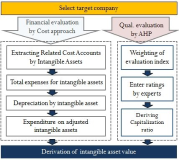
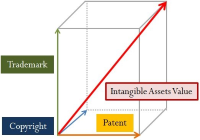
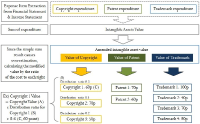
Purpose In the field of sports industry, the intangible assets of sporting companies often show discrepancies between accounting information and corporate value because of conservative current accounting standards. Therefore, this study intends to present a valuation model of intangible assets of sports industry based on cost approach, as a part of a method of capitalizing intangible property expenditures. And we tried to verify the valuation model of intangible assets derived from the research on actual sports companies. Methods To accomplish the purpose of the study, reviewing the literature on various related precedent studies and examining related valuation methodology, legal basis, and representative valuation models were utilized. And to verify the effectiveness of the derived model, Tobin q values were derived and compared. A simple regression analysis was used to verify the explanatory power of the derived model. Results The financial evaluation was conducted based on the cost approach, which enables relatively objective evaluation through the existing financial statements, and a valuation model with the procedure of duplicating the AHP evaluation to reflect the characteristics of the individual intangible assets was presented. In addition, in order to verify the proposed valuation model, the valuation was conducted by putting the accounting information of the sports companies into the intangible asset valuation model presented in this study. As a result of the statistical analysis on the evaluation results, the intangible asset value evaluation model presented in this study is proved to be significant based on statistically high explanatory power. Conclusion Therefore, if it is possible to appropriately evaluate the enterprise value of sports companies through the intangible asset valuation model based on the cost approach presented in this study, various types of technology financing will be possible in the sports industry. And this is expected to accelerate the growth of the sports industry in the future.
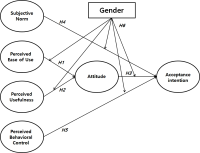
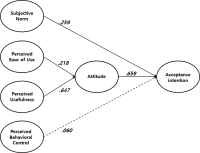
Purpose The current study was aimed to examine acceptance intention of sports wearable smart device using the Technology Acceptance Model and Theory of Planned Behavior. Methods Data were drawn from 357 consumers who had experience purchasing sports products. Data were analyzed through frequency analysis, reliability analysis, confirmatory factor analysis, correlation analysis, and structural equation modeling using SPSS 20.0 and AMOS 20.0 program. Results First, perceived ease of use had a positive effect on attitude. Second, perceived usefulness had a positive effect on attitude. Third, attitude had a positive effect on acceptance intention. Fourth, subjective norm had a positive effect on acceptance intention. Fifth, perceived behavioral control did not affect acceptance intention. Sixth, differences of path coefficients between attitude and acceptance intention, subjective norm and acceptance intention were significant according to gender. Conclusion The significance of this research is to provide the basis of positioning strategy for domestic companies of sports wearable smart device.

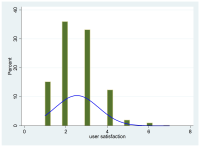
Purpose The study aims to analyze the factors affecting the Residents user satisfaction in order to improve the management of the Open School Sports Center the support facility of the National Sports Promotion Fund. Methods This data is based on Korea Institute of Sports Science(KISS)'s Open School Sports Center Usage Status and Satisfaction Survey (2016) and Open School Sports Center use performance. The analysis model is a regression model (TOBIT) that takes into account the limited characteristics of dependent variables. Results The results are as follows: the satisfaction is negatively related age, number of regulations, weekday opening hours, and usage fees. Conclusion Therefore, in order to increase the satisfaction of Open School Sports Center residents users, various supports are needed. This includes funds for PR, discounts and user-friendliness. It also requires differentiated management of each Center. In the case of regions and facilities, consumer-oriented policies need to be applied instead of collective standards.
Purpose The purpose of this study is to investigate the factors for setting proper training duration of frequency that can guarantee the student athletes' right to study and performance, and to derive the ranks of setting proper training duration of frequency of student athletes by school level. Consequently, to provide basic data for the development of training guidelines for the growth period of Korean student athletes. Methods Delphi and Analytic Hierarchical Process(AHP) techniques were used. The Delphi survey was conducted in three phases, and collected data through Delphi survey were computed by SPSS win ver. 22.0 and Excel, using the mean, standard deviation, median, and coefficient of variation. Using the AHP technique, we classified the factors for setting proper training duration of frequency derived through Delphi survey, and calculated the importance by using Microsoft Excel 2010. Conclusion First, elementary students should be guaranteed regular class participation, have basic after school training, and be provided with adequate rest so that they do not lose interest in the exercise. Second, middle school students are required to decide whether to continue exercise based on their ability to exercise and abundant experience. Therefore, when abandoning the exercise, students should be able to faithfully carry out their academic performance. Third, high school students are directly related to college entrance and employment, so they have to concentrate on performance rather than on academic performance.
