
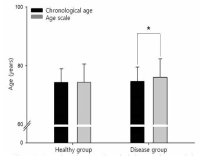
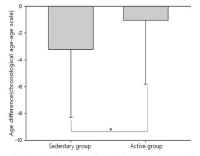
Purpose Evaluating the aging of senior and providing optimal sevices are important things for successful aging. This study identified functional fitness related with heath of aged 65 years or older and developed an age scale (longevity fitness age) for assessing their aging. Methods Participants were 458 older people (166 male, 292 female). They were divided into healthy group and disease group. Healthy group was used for the development of the longevity age equation and disease group was for investigating the validity of the equation. Participants completed 13 function fitness variables. The first principal component obtained from a principal component analysis was used to compute the equation. All variables except for grip strength and carrying beans were correlated with chronological aged. Grip strength and variables related lower functional fitness had differences between healthy group and disease group. Finally, 4 variables were selected for the equation. Results It was the following: longevity fitness age=0.942*X1+2, 185*X2+0.673*X3+0.051*X4+0.588*chronological age+58.401, where X1=standing up from a supine position, sec (s), X2=maximum walking (s), X3=standing up and sitting down a chair (s), X4=one leg balance with eyes open (s). The longevity fitness age of healthy group do not have a difference compared to their chronological age but disease group had a difference significantly. Age difference (chronological age-longevity fitness age) of sedentary group in disease group was significantly bigger than its active group. Longevity fitness age could assess an aging of senior. Conclusion We suggest that it can use as the tool for early detecting senior who need the health care service.

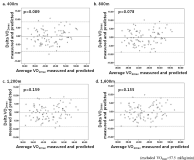
Purpose The purpose of this study was to develop the new indirect method assessing maximal oxygen uptake (VO2max) using heart rate (HR) and accelerometer during walk exercise. Methods One hundred seven participants (55 male, 52 female) performed a graded exercise test to determine VO2max and two types of 1,600 m walk exercises (fast walk and pace controlled walk). The equations for estimating VO2max was developed by stepwise multiple regression. The validity of developed equations tested through the correlation between measured VO2max and estimated VO2max, was assessed by predicted residual sum of squares, and Bland-Altman plotting. Results VO2maxwas correlated with time, and HR/activity count per minute (ACM) measured in pace controlled walk exercise at all distance (400 m, 800 m, 1,200 m, 1,600 m). The equations were valid significantly and their multiple correlation coefficients or standard estimated error were similar to that Åstrand-Rhyming cycle ergometer test or Rockport 1 mile walk test. Using HR/ACM in pace controlled walk (400 m), it was possible to estimate VO2max(R2: 0.675, %SEE: 10.7). The equation was: VO2max=121.659+6.656×Gender-0.865×Age-9.540×Time-2460.952×HR/ACM (Gender, 0=female, 1=male: Time, hundredth of a minute: HR, heart rate: ACM, activity count per minute). Conclusion Estimation equations developed in this study are considered to estimate VO2max through a shorter distance, or a lower intensity of walk exercise. It is required studies to target a wide range of ages or to develop walk test on a lower bpm.

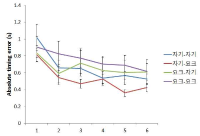
Purpose The present study was set up to investigate the effect of self-regulated learning and selection of feedback on learning of the relative and absolute timing. Methods 48 university student volunteers participated in the experiment and were randomly assigned four groups (n=12 for each) depending on practice task and feedback, namely: 1) self-regulated practice task - self-controlled feedback (self-self), 2) self-regulated practice task - york-controlled feedback (self-york), 3) york-regulated practice task - self-controlled feedback (york-self), and 4) york-regulated practice task - york-controlled feedback (york-york). The task was to examine the temporal timing error and the task goal was to press a computer keyboard 'J' and 'K' alternatively corresponding to time set. Prior to the experiment, the participants had a pre-practice session and then practiced one of three timing tasks provided by an experimenter in the acquisition phase. There were two transfer test to assess adaptability aspects of performing changes related to learning after 24 hours of the acquisition phase. Serial practice was applied in the transfer 1 and an effector transfer was examined in the transfer 2. The dependent variables were a relative timing error that is susceptible to discrepancy between the participant’s key press and the goal patterns and an absolute timing error that is susceptible to discrepancy in the time required to perform the sequence compared to the goal absolute time. Results The results showed that in the pre-test there was no significant difference in both the relative and absolute timing error across four groups. However, in acquisition phase there was a significant difference in both the relative and absolute timing error across block. The relative timing error was different across the group in the transfer test 1, however it was different only between the self-self and york-york group. Lastly, the absolute timing error was not different across the groups in the transfer test 2. Conclusion The findings revealed that the self-regulated strategy is effective to learn the relative timing in the effector transfer.





Purpose This study is a phenomenological research which tries to describe the subjective experience and to analyze multi-layered meanings, and it finds out the men's training experience and meaning. The purpose of this study is to investigate why the men do Yoga and what the subjective meaning of Yoga experience, and the study examines critically whether Yoga experience especially focused on women is against gender performance and dominant body discourse. Methods For the study, 6 middle & young-old aged men who do Yoga more than 6 months every week are selected as participants. Results The meaning of Yoga for middle & young-old aged men in their lives is as follows. First, it is hard for men to experience Yoga because of social and cultural background. Finding Yoga class which takes men's membership is difficult. Second, middle & young-old aged men's physical feature(interest in their health and disease) and personal background(women friendly daily life) become specific motivation to overcome the barrier to do Yoga. Third, Yoga is 'alterative training', not a training. Yoga is considered as a training which replaces the feature of training called men's sports previously. Fourth, Yoga has a meaning of 'healing' to have our own time. Fifth, Yoga is changed by itself in Yoga culture which is focused on women even though middle & young-old aged men do Yoga for a long time. Sixth, middle & young-old aged men realize that the feature of Yoga is not 'for only women', and they thought it is 'neutral training that men can do too.' Conclusion Consequently, the reason why middle & young-old aged men do Yoga is started from the motivation regarding physical characteristics and personal background, and the main purpose is to cure and to heal our bodies and mind. For them, Yoga means 'alternative training to fit their bodies' and 'their own time'. Moreover, old male adult's training experience and meaning are against gender performance in that it cause a crack in stereotyped gender sports area, but it is notable that there is no intention to resist the dominant gender body discourse.

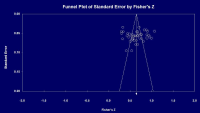
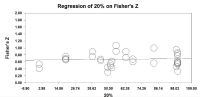
Purpose The purpose of this study was to conduct the impact of technology acceptance model(TAM) in sports field using a meta-analysis. Methods First of all, findings from 22 articles were used to analyze the relationship between perceived usefulness, perceived ease of use and intention to use via the comprehensive meta analysis(CMA) program. Results Its study results are as follows: First, results showed that TAM have a big effect on intention to use, with an effect size of .537. Second, the most influential effect size of TAM sub-factors was perceived usefulness. Third, in application and SNS had a most effect on TAM. Lastly, results found significant moderating evidence for ratio of female. But ratio of 20’s was not founded significant moderating evidence. Conclusion Based on the results of this study, it will be possible to pursue the behavior of the audience in the field where TAM is applicable in sports field.



Purpose This research was to empirically analyze the relationship between a commercial sports center customer-perceived employees' emotion labor (deep acting, surface acting) and sports center emotion, service quality & relationship retention through structural equation model analysis. Methods For this purpose, this study set 270 members at the two commercial sports centers(facilities equipped with more than 3 events) located in Suwon as the research subjects. In an effort to verify the proposed structural model, this study used SPSSWIN Ver. 21.0 and AMOS 18.0. Results first, this study found that deep acting had a positive effect on positive emotion. Second, it was found that surface acting had a positive effect on negative emotion. Third, deep acting was found to have a positive effect on service quality. Fourth, surface acting was found to have a negative effect on service quality. Fifth, the results showed that positive emotion didn't have a positive effect on relationship retention. Sixth, negative emotion was found to have a negative effect on relationship retention. Seventh, service quality was found to have a positive effect on relationship retention. Conclusion This findings indicate that the management of emotional labor is critical from the aspects of personnel management in sport centers.

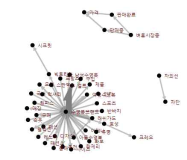
Purpose The purpose of this study was to examine the changing trends of swimsuit perception by using SNS big data. Methods By using “swimsuit” and “swimsuit brand” as key words, data was searched through blogs, cafes, Jisiksin(Tip), news, and web documents provided by naver and daum. This study used 2 years of data from January 1st, 2014 to December 31st, 2015 and social matrix program Textom was used for extracting matrix data and analyze them for frequency. To visualize data networking, NetDraw of UCINET6 program was used. Results Through analyzing the popular link words to the key words, it was known that the key words were 'swimsuit brand', 'children's swimsuit', 'rash guard', 'women's swimsuit', and 'model' in the order in 2014, and ‘swimsuit brand', 'rash guard', 'children's swimsuit', 'women's swimsuit', and 'Arena’ in the order in 2015. Second, the median of connectivity values showed that it was high in ‘swimsuit brand', 'women's swimsuit', 'children's swimsuit', 'rash guard', and 'Arena’ in the order in 2014, and ‘swimsuit brand', 'rash guard', 'women's swimsuit', 'children's swimsuit', and 'Arena’ in the order in 2015. Third, th results of CONCOR analysis demonstrated that ‘female customer’, ‘couple swimsuit’, 'rash guard', ‘brand’, 'children's swimsuit', and ‘fashion’ were grouped in 2014, and ‘brand’, ‘fashion’, 'rash guard', ‘purchase factor', and 'children's swimsuit' were grouped in 2015.




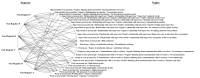
Purpose This study attempted to investigate the difference on job satisfaction and service quality between non-regular and regular workers in commercial sports facilities. Methods With the purpose of the study, the purposive sampling as the non-probability sampling method was used to intentionally select the representative cases. We conducted through utilizing in-depth interviews with 6 non-regular and regular workers, respectively, who have worked for more than a year at total commercial sports facilities holding more than 3 programs with more than 500 memberships. This study aimed to explain real phenomena as much as possible by utilizing NVivo 11, one of qualitative research method programs, on the basis of raw data. Results In conclusion, non-regular and regular employment types in commercial sports facilities did not affect service quality provided for customers. However, it was derived that there was a slight difference between regular and non-regular workers on job satisfaction. Conclusion It is necessary to improve the wage and compensation system for regular workers as well as the labor policy to improve treatment of the wage according to the qualification of non-regular workers in commercial sports facilities. In spite of the instability of non-regular workers, the effort of converting into regular workers would evoke organizational commitment, loyalty, and attachment of non-regular workers, when properly acknowledged.










Purpose This study was to examine the relationships among title sponsor's social inference(majority exposure, reliability, topicality, & social response), sponsor attitude formation(sponsor attitude, event sponsorship attitude, & communication attitude), and sponsorship effect (sponsor identification, attitudinal loyalty, and behavioral loyalty) in the professional volleyball contexts. Methods A survey was conducted by using college students (n=370) majoring in sport and physical education at four universities located in Chungcheong Province. The data were recorded and analyzed using the SPSSWIN Ver. 21.0 and AMOS 18.0 to analyze the structural equation model. Results First, the increased majority exposure had a significantly negative effect on sponsor attitude. Second, reliability was found to impact significantly on sponsor attitude. Third, topicality was found to impact positively and significantly on sponsor attitude. Fourth, social response did not show significant impact on sponsor attitude. Firth, sponsor attitude was found to significantly influence on event sponsorship attitude. Sixth, sponsor attitude had positive impact on communication attitude. Seventh, event sponsorship attitude was found to impact positively and significantly on sponsor identification. Eighth, communication attitude was found to impact positively and significantly on sponsor identification. Ninth, sponsor identification was found to impact positively and significantly on attitudinal loyalty. Tenth, sponsor identification was found to impact positively and significantly on behavioral loyalty. Finally, attitudinal loyalty was found to impact significantly and positively on behavioral loyalty.

Purpose This study aims to find out the attitude changes of consumers on a corporate sponsor in a cause related marketing based on frequency of information exposure and the image of the sponsor. Methods The data were collected from 191 students of C university in Seoul and its vicinity. The data were collected three times from the sample to see the attitude changes over time. The hypotheses of the sutdy were developed based on meaning transfer theory and spreading activation theory. This study hypothesized that the attitude toward a sponsor would change in a positive direction when consumers are exposed to related information and the change would be moderated by the frequency of information exposure. Also, the changes in attitude would be different based on the image of sponsors(i.e., positive image sponsor vs. negative image sponsor). The hypotheses were analyzed using mixed-design ANOVA. Results The results of the analyses indicated that the attitude change was greater when the frequency of information exposure was higher. The attitude change in positive image sponsor was statistically lower than that of negative image sponsor possibly due to ceiling effect.

