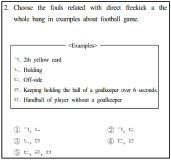
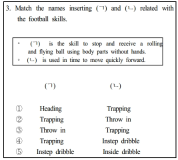
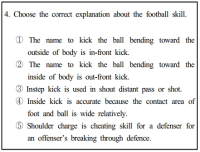
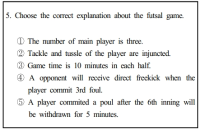
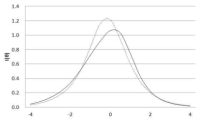
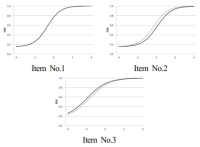
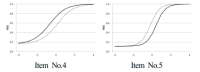
The purpose of this study was to analyze and confirm whether the items used in final paper and pencil test was determined to DIF when school sports clubs in each school operated by discriminatory curriculum in accordance with gender. Participants were 8th middle school students(male=135, female=141). They joined in school sports club every week from freshman to sophomore 1st semester. At that time, boys of them participated in soccer and basketball, and girls played dodge ball. They studied soccer unit at sophomore 1st semester, and had a final examination consisting of 5 soccer items. Using the data, differentially functioning item by the population difference between male and female were analysed quantitatively and qualitatively. The results showed that Mantel-Haenszel method(using classical test theory), comparison of item characteristic curve and likelihood ratio test(using IRT) determined item number 4 and 5 to differentially functioning item. Finally, item number 4 were identified differentially functioning item in favor of male students in intensive qualitative analyses. That item have low content validity and application-level of cognitive behavior classification. The result provides that application-level item can be functioning differentially to female students with little sports experience than male students in paper and pencil test of PE.

Purpose: This study was to verify the relationship between coaching behavior(autonomy/controlling behavior), self-regulation motivation and performance. Method: 356 athletes (from middle to work and professional team) in individual and team sport completed coaching behavior scale developed by this researchers assessing autonomy and controlling coaching behavior perceived by players, Korea Basic Pyshoclogical Needs Scale (KBPNS) assessing basic psychological needs, Behavioral Regulation in Sport Questionnaire (BRSQ) assessing sports motivation level based on self-determination theory, and sport performance score. To estimate the relationship between coaching behavior, self-regulation motivation and performance, this study employed the structure equation modeling analysis. Results: The relationship between psychological needs, regulation motivation and performance showed that autonomy coaching behavior tend to reinforce competence and autonomy of player. These variables have a positive effect on more inner regulation motivation. Moreover, the intrinsic motivation through stimulation experience was a key factor leading to a positive performance by improving the performance strategy and skill of athletes. Conclusion: These results are meaningful as an empirical evidence that relationship between motivation and performance can be changed according to the type of coaching behavior, and that autonomous coaching behavior play an important role in maximizing the performance of player that provided theoretically form.
Purpose : The purpose of this study was to investigate coaching information with which coaches provided players during badminton competition. Methods : To this end, we generated an open-ended questions and presented it to 88 high school athletes registered in the Badminton Korea Association. The survey was conducted during a tournament and immediately after the tournament to collect the data. The collected data were categorized through inductive content analysis. Results : As a result of this study, a total of 480 raw data points collected through the open-ended survey were categorized into four general areas: psychological information, technical information, tactical information, and game operation information. Specifically, psychological information was divided into six subdivisions: concentration, confidence, relaxation/stabilization, mental toughness, play thought, and passion; technical information was broken into four subdivisions: strokes, footwork, swing and posture, and position preparation; tactical information had four subdivisions: coping to opponents, play changes, rotation, and manipulation of opponents; and, game operation information was divided into two subdivisions: taking the lead in a game and changing atmosphere. Conclusions : In other words, in badminton competition, the coaches strengthened psychological skills that promote psychological stability to attain the athletes’ peak performance and modified the athletes’ motion into the action necessary for achieving accurate techniques. Furthermore, they provided a variety of coaching information so that the athletes will respond appropriately to their opponents’ play, take the lead in games and induce a positive mood. The psychological, technical, tactical and game operation information offered by badminton coaches are the main factors influencing the performance of badminton players and suggest a need for the proper management and control of the coaches as well as athletes for the peak performance.
The recent increases in international efforts for designing and implementing initiatives and programs about 'development though sport' have accompanied the remarkable growth of the 'sport for development and peace'(SDP) sector. This global prevalence of SDP and the resulting augmentation of its social significance have rendered a growing scholarly attention to SDP in the sociology of sport. Moreover, a grounding rationale for SDP initiatives to enhance positive individual and social changes through sport has also offered an interesting research area for the sociology of sport. This paper aims to review sport sociology literature about SDP. Major findings include a set of descriptive reports about the institutionalization of SDP and critical/reflective approaches to SDP's outcomes and limitations. It is noted that the institutionalization of SDP consists of ideological and policy endeavors, SDP organizations and institutions, and classifications of SDP project types. Despite of positive outcomes resulted from SDP programs, it has been highlighted that the ongoing issues and limitations of SDP include ambiguities of development concept, the Global North hegemony, unilateral top-down program management, and the inherent complexity and lack of program monitoring/evaluation.
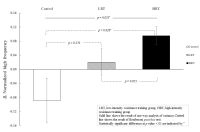
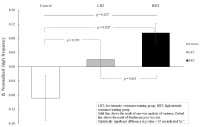
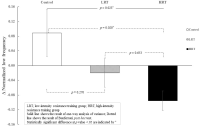
The purpose of this study is to investigate the influence of resistance training with different exercise intensities on heart rate variability(HRV) in habitual smokers. Twenty-eight healthy young smokers participated in this study were randomly divided into three groups; CON(control), LRT(low-intensity resistance training; 50% 1RM), and HRT(high-intensity resistance training; 70%1RM), respectively. LRT and HRT groups performed an 8-week resistance training(4 upper- and lower body exercises) using weight training machines, whereas CON group maintained their regular activities. All groups were evaluated basal body composition, hemodynamic parameters, HRV as autonomic nervous function, and muscular strength (1RM and isokinetic test) before and after the 8-week training. To assess the effect of 8-week training with different intensities on autonomic regulation, time and frequency domain indices of HRV were calculated from 5min R-R interval recording. As results, both LRT and HRT groups increased baseline 1RM and isokinetic strength compared to CON group. Meanwhile, high-frequency power reflecting parasympathetic activity was significantly increased in HRT compared to CON group. In addition, normalized low frequency power(LF nu) indicating a shift of sympathovagal balance towards sympathetic predominance significantly decreased while normalized high frequency power(HF nu) which reflects vagal predominance significantly increased in HRT compared to CON group. Furthermore, improved cardiac autonomic regulation and parasympathetic activation had significant association with increased muscular strength. Overall, the 8-week training has enhanced muscular strength in both training groups, particularly autonomic balance improved in young habitual smokers with high intensity resistance training.
The purpose of this research is to provide the information about sports injury by surveying and analyzing a result, and to lead analytic and scientific training among the subjects being elite summer sport athletes. All sports injuries are recorded on injury report form and the following results were obtained. In Cycle sport, the prevalence of injuries of the low back, knees were highest. and In Table tennis sport, the prevalence of injuries of the ankle was highest due to the chronic fatigue. The prevalence of injuries of the shoulder, low back were highest due to the overuse of joints. In Badminton sport, the prevalence of injuries of low back, knees, ankles were highest by overtraining. In Gymnastics, the prevalence of injuries of the low back, knees, ankles were highest. In Archery sport, there is a lot of injuries to the shoulder and neck. In Weight lifting sport, the prevalence of injuries of the low back, knees, and ankles were highest. In Golf sport, the prevalence of injuries of knees, low back were highest. In Hockey sport, the prevalence of injuries of ankles, knees, low back were highest. In Boxing sport, the prevalence of injuries of hands, shoulder, the low back were highest, In Judo sport, there are overall damage occurred in parts of the whole body, but the prevalence of injuries of ankles, knees, low back were highest. In Fencing sport, the prevalence of injuries of the low back, knees were highest. In Wrestling sport, although there is a difference slightly depending on freestyle and Greco-Roman, but the prevalence of injuries of knees, ankles, low back were highest. In Handball sport, the prevalence of injuries of ankles, knees were highest. In Taekwondo, the prevalence of injuries of ankles, knees, feet were highest.
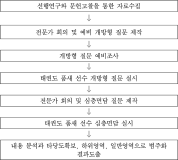
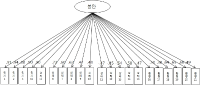
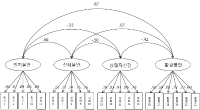
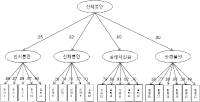
The purpose of this study was to develop and validity Competitive State Anxiety Scale for Taekwondo Form athlete(CSATF). The participants were composed of the 48 Taekwondo Form athlete to explore sub-factors of Competitive State Anxiety for Taekwondo Form athlete. The data were collected by an open-ended questionnaire and interview. The participants were composed of 257 national Taekwondo Form athlete to develop Competitive State Anxiety Scale for Taekwondo Form athlete. This 157 athlete data were used for items analysis, reliability analysis and exploratory factor analysis. And 100 athlete data were utilized for confirmatory analysis. Also convergent validity, discriminant validity, predictive validity latent mean analysis of CSATF were performed The results of this study were as follows. Firstly, the results revealed that the four general dimensions were identified such as cognitive anxiety, somatic anxiety, state of confidence, environmental anxiety. Secondly, CSATF comprised cognitive anxiety(5 item), somatic anxiety(5 item), state of confidence(5 item) and environmental anxiety(6 item). Thirdly, convergent validity, discriminant validity and predictive validity, the multi-group analysis according to gender examined validity of CSATF.
The purpose of this study was to describe psychological changes and variables of injured elite athletes during sport injury rehabilitation. 5 injured elite athletes were selected as participants, and open-ended questionnaires, participant observation, and in-depth interview were used for collecting data. Results from the data were analyzed through transcription, coding, and categorization with inductive method. To validate the results of this study, triangulation, in-depth description, member checks, and peer debriefing were used, and findings of this study were as follow. The participants showed negative psychological state such as fear of return to play and anxiety during the initial rehabilitation program, but their psychological state was changed positively such as recovery of confidence and desire of return to play at the end of program. However, the specific psychological changes of each participant showed several differences according to participant's surrounding environment and situation during the rehabilitation program. All findings have important implications for implementing and developing rehabilitation program, so needs to be investigated further.
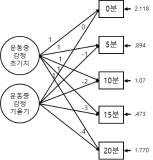
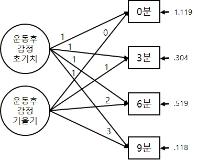
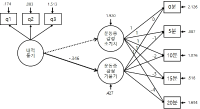
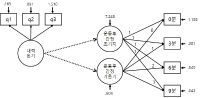
Recent research on exercise and affect has examined participants` affective changes during and after exercise with a longitudinal approach. With regard to this viewpoint, a theoretical model (Dual Mode model) has been presented to explain the different change of affect in an exercise setting and the model identified the impact of psychological factors on the affective changes. However, not only there is little empirical studies on the dual-mode model, but some relevant research has used an inappropriate statistical method (ANOVA), which cannot effectively explain the overall trends in affective change during and after exercise. Exiting research has a limitation to generalize the DM model examining only a certain gender such as active male or inactive female participants. Thus, the aim of present study was to investigate the effect of intrinsic motivation on affective change during and after exercise in participants who do not take part in regular exercise considering gender based difference. 51 inactive university students (M: 36, F: 15) responded a survey measuring intrinsic motivation for running activity and participated in moderate-intensity running exercise to examine affective change during exercise. Therefore, present study examined the influence of intrinsic motivation as a psychological variable on the trend of affective changes during and after exercise based on the dual mode model. Results from the latent curve model analysis revealed that there were decreasing trends of affect during exercise and the trends were individually different. Importantly, the decreasing trends were weaker in the participants with higher intrinsic motivation[FL=-.34, p=.000]. Additionally, participants` affective responses were positively changed after the exercise in general, but the changes were not influenced by intrinsic motivation. Therefore, the decreasing trend of affective change during exercise was weaker in the participants with higher intrinsic motivation, and the positive change in affect after exercise was not influenced by intrinsic motivation.
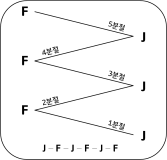
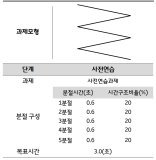
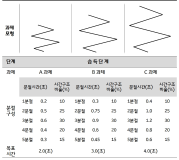
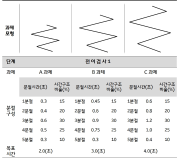
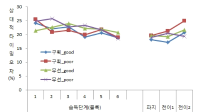
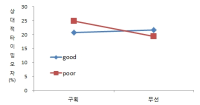
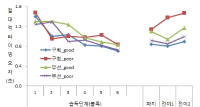
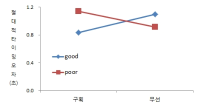
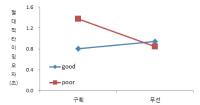
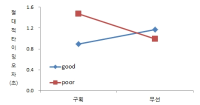
The present study was conducted to determine the effect of contextual interference (CI) and motivational properties (MP) of Knowledge of Result (KR) in learning on relative and absolute timing. Participants (N=48) were randomly assigned to one of four practice groups, which differed in practice structure on CI (blocked, random) and KR on MP (good trial, poor trial). They performed temporal timing tasks in pre-exercise and acquisition phase and went through a retention test and 2 transfer tests after approximately 24 hours. The main findings showed that first, for the relative timing error there was no significant main effect of CI and MP in the acquisition phase, retention, transfer1, and 2 test. However, there was a significant interaction effect between CI and MP in the transfer 2 test. Second, for the absolute timing error there was no significant main effect of CI and MP in the acquisition phase, retention, and transfer test 2 while there was in the transfer test 1. Moreover, there was a significant main effect between CI and MP in the retention, transfer 1, and 2 test. The findings indicated that 1) there was a significant learning effect of absolute timing between KR_good group and KR_poor group on blocked practice in the retention test, 2) random practice schedule and KR_good condition resulted in enhanced absolute timing performance relative to blocked practice and KR_poor respectively at transfer test 1, 3) there was a significant learning effect of absolute timing between KR_good group and KR_poor group on blocked practice at transfer test, 4) KR_good condition could be an useful relative timing learning strategy relative to KR_poor on blocked practice schedule at transfer test 2, effector transfer test. KR-good condition resulted in learning superior to KR_poor group on blocked practice schedule as well. However, there was no significant difference between two conditions on random practice, and 5) there was no difference in the learning effect of absolute timing error between KR_good and KR-poor group in the blocked practice, while there was not in the random practice. It indicated that motivational properties would influence the learning effect of timing in the blocked practice.