
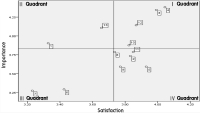
Purpose The purpose of this study is to grasp consumers' perception of badminton racket brand image using MDS and ISA. Methods To do this, we conducted questionnaires on those who participated in badminton and had experience of participating for 6 months or more in Seoul and Gyeonggi province from April 12 to 28, 2017, selected and analyzed a total of 313 copies as valid samples of this study. Results The results of study are as follows. First, as a result of MDS analysis, it showed that only the price of brand image attributes were in order of Trion > Joobong > Lining > Victor > Yonex, and the other attributes(Design, Functionality, Quality, Awareness, Advertising image, Event, Color, Popularity, Sophistication, Originality, Trust, Service) were in order of Yonex > Victor > Lining > Joobong > Trion. Second, as a result of ISA analysis, in I quadrant, Yonex showed functionality, quality, sophistication, and trust and Trion showed price, design, functionality and quality, Victor showed price, design, functionality, quality, color, sophistication, trust, service, and Joobong showed price, functionality, quality, and trust in this area. In quadrant Ⅱ as concentrated area, Yonex showed price and service, Trion showed color, trust, service, Victor showed price, Lining showed trust and service, and Joobong showed service in this area. In quadrant Ⅲ as low rank, Yonex showed advertising image, event, Trion showed awareness, advertising image, event, popularity, sophistication, originality, Victor showed advertising image, event, popularity, originality, Lining showed awareness, advertising image, event, popularity, originality, and Joobong showed design, advertising image, color, popularity, sophistication in this area. In quadrant IV as excess avoidance, Yonex showed design, awareness, color, popularity, originality, Victor showed awareness, Joobong showed awareness, event, originality in this area.




Purpose The purpose of this study is to find effective skin scuba activation factors and to provide basic data that extend the scope of research related to skin scuba. Methods Delphi method was used and the experts were categorized by experts to analyze the results. The questionnaires collected through the 2nd and 3rd delphi surveys were SPSS win ver. 22.0 and Microsoft Office Excel 2013 to calculate mean, standard deviation, median, and coefficient of variation. The concrete conclusions are as follows. Conclusions First, in terms of organization sub-factor, fostering sports-for-all participants and college club came out to be very effective and followed by cooperation system with Ministry of Public Safety and Security and Ministry of Oceans and Fisheries, strengthening cooperation and exchange with other education organizations, initializing new scuba diving education organization management and inspection institution and establishing scuba diving education organization. Second, in terms of facility/equipment sub-factor, factors that cause most effectiveness came out as expanding scuba-diving installation, developing connection system with medical department, enlarging indoor-diving education facilities, improving scuba diving equipment, consecutively. Third, in terms of leader sub-factor, training instructor through leader personality education and verification came out to be the most effective, followed by objectifying professional education institution leader training system, improving leader treatment. Fourth, in terms of program sub-factor, it is found that safety education program as the most effective factor, coming next with environment education/professional manpower training program, developing various programs, lastly, inventing insurance product. Fifth, in terms of advertisement sub-factor, as in order of guiding publics to change their view towards scuba-diving, expanding scuba-diving related events and establishing advertisement system had its effectiveness. Sixth, in terms of policy sub-factor, establishing cooperation system among administration departments came out to be most effective and then improving related law-system.
Purpose The purpose of this study is to examine the elite sport system in Germany by selecting six keyword. Methods In order to review the literature, we reviewed the reports of sports organizations such as the Ministry of the Interior, the Olympic Games of Germany, the Sports Council of Germany, and the German sports policy, history, business, programs and financial status. Conclusion In Germany, athletic associations were created in the 40s and 50s and strengthened infrastructure, projects, and workforce infrastructure by the 60s and 90s. Through its long history and tradition, Germany is at the forefront of both the Winter and Sommer Olympics. Among them, the German Olympic Sports Federation, researchers Institute, Olympic training centers, Sports School, Kader-systems and federal police·military·customs are the main keyword of elite sports. In order to support the national players in Germany, the regional Olympic training center supports sports science, sports gymnasium, sports athletic high school, sports elite school, athletes' house are operated for selection and training of excellent athletes. And all the players are in the carder system and there is a system that allows them to enter the federal police, soldiers and customs so that they can support the human resources, facilities and programs as well as train and work at the same time.

Purpose This study was to explore construct of fear and courage behavior overcoming the fear and relationship between fear and courage in competition. Methods Total 65 national athletes of combat sports(Judo, Boxing, Taekwondo, Fencing) responded to open questionnaire about fear and courage behavior in competition. The data was analyzed by triangle verification and content analysis. Results Firstly, the fear of combat sports athletes consisted of five factors, which were negative consequences, lack of preparation for a game, concerns of performing one’s best, expectation of significant others, and internalized ego threat. Secondly, courage behaviors to overcome fear were self-effort, self-suggestion, self-conviction, selfish self-regulation, social self-control, self-analysis, and acceptance of experience. Finally, there were the relationship between fear and courage in competition. Conclusion These results will contribute to provide useful information for combat sport athletes and coaches in different level to cope with competition fear.
Purpose This study seeks to explore the process where drop-out elite athletes collect their life skills obtained during their sports career and transfer them to their daily lives. Methods An open-ended questionnaire survey was conducted on a total of ninety retired elite athletes and the responses were analyzed. Based on the results of inductive analysis, five subjects were selected for a follow-up in-depth interview. The responses to the open-ended questionnaire were analyzed by the inductive content analysis method and the results from in-depth interviews by the deductive content analysis method. Results A total of 478 life skills were collected from the drop-out elite athletes and structuralized into four general categories: psychological skill, social skill, self-management skill, and goal-setting skill. The results of this study have revealed that life skills positively transferred to their future courses of lives and daily lives. Conclusion It is believed that the results of this study will be helpful to understanding the concept of sports life skills, studying the possibility of transfer, and provide the basic data for helping drop-out elite athletes with re-socialization and positive adaptation.

Purpose This study was conducted to investigate the appropriateness of the concept of condition for athletes and to conceptualize condition in a way suitable for field and then to produce a tool to test condition that reflects usability. Methods 30 college athletes and national athletes with more than 5 years of experience were selected. In the conceptual review stage, the appropriateness of the concept of condition was verified. In the conditional element collection stage, the condition concept reflecting usability was extracted. In the development stage of the conditional questionnaire, a condition questionnaire was developed in consultation with the data provider to reflect usability. Results Previous studies on the condition of athletes were complicated and the necessity for consideration of usability was raised. As a result of conceptualization with consideration of the application to the sport scene, condition in a scene is summarized into both physical and psychological states. As a result of the appropriateness evaluation of the tool that produced the condition inspection tool reflecting the condition element based on universality and peculiarity of conditionality, the athletes evaluated that the condition inspection tool properly reflects condition, is easy to apply and can be used for condition control. Conclusion The development and application of psychological testing instruments reflecting usability will accelerate the application of sports psychology in the appropriate direction. The reflection of usability will contribute not only to the reliability and validity of the psychological testing tools used in the field of sports psychology, but also to the improvement of the possibility of intervention by leaders and athletes, the convenience of development procedures, and the utility of response results.

Purpose The purpose of this study was to examine the relationship between performance factors and physical fitness in secondary school female biathlon athletes. Participants in this study were 14 female biathlon athletes. Methods All factors such as aerobic capacity(VO2max, %AT), wingate test(peak power, average power, fatigue index), isokinetic test(trunk, knee, hip, ankle), 1RM test(leg press, chest press, lat pull down), physical fitness(grip, knee and back muscle strength, sit & reach, power, agility) were tested. In order to analyze collected data, pearson product moment and multiple regression analysis were utilized. The results were summarized as follows : First, there was a significant correlation between aerobic. Results The results were summarized as follows : First, there was a significant correlation between aerobic capacity and three factors(standing broad jump, isokinetic test 60° right knee extension)(p<.01). There was a significant correlation between wingate test and four factors(isokinetic test 30° left ankle ever, 30° right ankle ever, 120° left ankle inver, leg press)(p<.10). Conclusion These results suggested new evidence that ankle strength is necessary for performance in female biathlon athletes.

Purpose The purpose of this study was to compare the technique and power of the Korean national athletes and international athletes in the start phase of the 500 m speed skating to improve the performance and to understand the relationship between the biomechanical variables affecting the record. Method The subjects were 8 Korean national athletes (Korean athletes) and 6 international athletes (international athletes). For the three dimensional motion analysis, 5 high-speed cameras were used to capture the 40 m start phase of the athletes participating in the international competition. The variables selected for analysis were the kinematic chain, 100 m net time, time to 9 strokes, horizontal position of center of mass after 2.5 sec, range of motion of trunk, knee, push-off angle, net power output, total power loss. Results The correct kinematic chain ratio of Korean athletes was 61.2%, which was lower than 76.0% of international athletes. The time to 9 strokes was 2.82±0.25 sec for Korean athletes, which was significantly lower than 2.53±0.11 sec for international athletes (p=.001). The range of motion of the push-off angle was 60.15±2.75° for Korean athletes, which was significantly lower than 64.76±2.55° for international athletes (p=.001). The net power output was 887.2±269.9 W for Korean players and 1103±264.1 W for international players (p=.021). The variables related to the 100 m net time were the horizontal position of center of mass after 2.5 sec (r=-.956, p=.001), the net power output (r=-.931, p=.001), and the total power loss (r=-.904, p=.001). Conclusion In order to improve the start performance of Korean athletes, it is necessary to maximize the efficiency of skating through skill training to use the correct kinematic chain. Also power enhancement training is needed to improve leg power because the net power output related with 100 m net time.

Purpose This study was carried out for the purpose of providing national players of our country by grasping various techniques and difficulty composition of world-level players. Methods For doing so, this research was executed by objecting 9 finalists in parallel bar of 2012 London Olympics and 8 finalists in parallel bar of 2016 Rio Olympics. Collected datum were treated with average, standard deviation, percentage (%) by using SPSS 18.0, and they was analyzed while securing feasibility through expert meeting. Results Research results are same as follows. First, Rio Olympics players appeared higher than London Olympics such like 6,61 points in average D-score of 2012 London Olympics final game and 7.0 points in average D-score of Rio Olympics final game. Second, I group was turned up to prefer Healy technique (34.88%) of D difficulty in two olympics. Third, Ⅱ group carried out Bwd. uprise and salto fwd. p. to sup technique of D difficulty by each 4 players (36.35%) in two olympics, so the technique was displayed as preferred techniques of players. Fourth, Ⅲ group executed at the London Olympics, C difficulty was the most frequently used, but at the Rio Olympics, D difficulty and E difficulty were the most frequent. Fifth, Players in London Olympics and Rio Olympics executed Basket to hdst technique, and it appeared to be most preferred technique by players. Sixth, Ⅴ group executed at the London Olympics, D difficulty was the most frequently used, but at the Rio Olympics, F difficulty was the most frequent. Conclusions These findings will be useful datum to gymnasts and instructors of our country by providing valuable datum in preparing 2020 Tokyo Olympics after grasping preferred techniques and trends of world-excellent players.
Purpose The purpose of the study is to review the current trends of Korean research on sport volunteering. Methods For the research purpose, 74 KCI-listed articles published were investigated. Results The main topics of 60 articles were sport volunteering and the sub-topic or factor of the other 14 articles was sport volunteering. These articles were classified based on the publishing year, type of journal, academic area, research method, research topic, research sample, volunteer characteristics and volunteer area. Research on sport volunteering has been continuously conducted but the number of related publications has been increased since 2009. Sport volunteer research articles have been published in various sport related journals. However, the majority of the research articles are in the research areas of sport management, sport pedagogy, adopted physical education, and sport policy. Regarding the research method, more than a half of the articles were the ones using quantitative research methods, but qualitative research methods were often used as well. The majority of the research were conducted on volunteers but the research conducted on the beneficiaries of volunteer services were few. Many of the volunteers researched were college students. Event volunteering and educational volunteering were common volunteering areas in the research articles. Conclusions Korean researchers should not only conduct more research on sport volunteering with various topics but also improve the quality of the research after conducting the in-depth review of theories and literature and the better understanding about Korean situation on sport volunteering.
