The purpose of this study was to analyze the differences among behavioral skills of goalkeeper of K-League and national team and the differences among behavioral skills of goalkeeper according to game the result of match. 5 games of K-League Classic and 10 A matches of the national team in 2013 were analyzed by using Soccer Data Analysis Program and ‘Evermedia HD Capture Station’, which is an HD capture equipment with excellent functions of editing and storage of high-definition video. For statistical analysis process, SPSS Version 21.0 was used to conduct t-test and ANOVA. The results of analysis were as follows: First, the differences among behavioral skills of goalkeeper of K-League and national team were higher in the order of catching factor, kick factor, strategy factor, punching factor. The differences among the specific sub-factors of behavioral skills factors was the highest in crossing catching to be followed by cross punching. And goalkeepers of K-League were higher than those of the national team. In back pass kick factor in kick factor and build-up factor in strategy factor, goalkeepers of the national team were higher than those of K-League. In kick factor, there were significant differences in goal kick (out of play), back pass kick (in play), cross punching, and build-up factors. Second, as for behavioral skills factors of goalkeeper according to the result of match, there were significant differences in catching factor, punching factor, and strategy factor; there were no significant differences in ground kick factor among kick factors; there were significant differences in factors of goal kick, volley kick, and free kick.
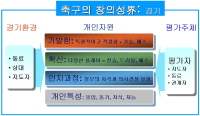
The purpose of this study was to explore a framework of understanding football performance. Researcher review was conducted to organize perspectives for football performance and drew implications as well as drift of football performance based on intelligence approach. Discussions for intelligence had been proceeded in concepts of learning ability, multiple intelligence, successful intelligence, and moral intelligence. Discussions of football performance approaches fitness, skill, and strategies in traditional intelligence aspects. The multiple intelligence perception discusses perspective, mentality, body, and analysis. The successful intelligence perspective deals with creativity, practical intelligence, and football talents. However, specific discussions for moral intelligence have not been progressed yet. FIFA’s social responsibility project and UEFA’s RESPECT campaign reflect that the discussions of football performance develops in a way of the moral intelligence. In European football, issues regarding value, such as RESPECT and against Racism, are currently emerging. Considering the change in the European football, the global football leagues will share the issues related to value in the near future. Given the fact that discussion for intelligence had been proceeded learning ability, multiple intelligence, successful intelligence, and moral intelligence, the moral intelligence will be a main concern in the further football performance discussion. The moral intelligence will be incorporated into football performance evaluations soon. Furthermore, teams and players will strive to place efforts in order for pursuing value and reputation as factors of performance.




This study aimed to analyze the patterns of service return and the 3rd stroke in relation to the winning and losing points in Badminton men's doubles matches. Especially the comparison of the patterns between rally point and service server game systems was made. Video records of 12 top elite teams were analyzed. As a result, there were significant differences in the total stroke patterns between the rally point system and the server game, and there was a higher offensive stroke tendency. After classification of situations with ‘after the service trial’ and ‘after the service return’, there were high number of winning ratio and offensive stroke in the after the service situations. There were no significant difference in the winning/losing points and winning ratio when the types of 3rd shot attempts were analyzed. I case of the win and lose in service return, there was a significant difference in the server game while not in the rally point system. Offensive stroke ratio in the server’s return categories and the service return strokes’ categories, and was no difference in shots after the return of service in the server team. From the investigation of offensive stroke ratio and winning ratio, there was a high ratio in the rally point system game but no difference in the server game. When aggressive service return took place, rally point system had higher winning ratio, but the server game system did not display such characteristic. Based on these results, recommendations of service anticipation and aggressive plays for Korean Men's doubles game have been suggested.
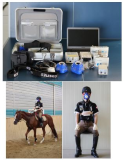
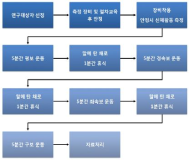
The purpose of this study was to examine the intensity of horseback riding as exercise (heart rate, oxygen intake, respiration exchange ratio, metabolism, energy expenditure) according to the tread of a horse such as walking, rising trotting, sitting trotting, and cantering. In this study, the subjects were 15 amateur horse riders. They participated in a 4-stage process(riding while the horse was walking, rising trotting, sitting trotting, and cantering) while wearing gas masks and heart rate belts for 5 minutes during each stage. Through this study, the average of heart rate, oxygen intake, respiration exchange ratio, metabolism, and energy expenditure in each stage of riding was attained and compared. The result of this study can be summarized as follows. First, the intensity of exercise by horse riding is significantly different depending on the tread of a horse. The intensity of exercise is increased as the speed of the horse's movements increased. Trotting and cantering show higher intensity than walking. Among the different treads of a horse, walking can be categorized as having an intermediate intensity of exercise, whereas trotting and cantering are categorized into a higher intensity. However, there are no significant differences in intensity between trotting and cantering. Second, there are no significant differences between male female participants in terms of intensity of exercise, but there are differences in the energy consumption per minute. The weight differences between male and female participants may be what cause this difference.
The purpose of this study was to investigate the effects of National Fitness Award program group exercise classes on daily fitness and balance-confidence among the elderly participants(n=496, 80.2% women). This study investigated body composition, daily fitness, and balance-confidence, and quality of life among the subjects who participated in the combined exercise program of improving physical fitness class for 8-week in the 10 national physical fitness certification centers by the demonstration project for the elderly of 2013 Korean National Fitness 100 project. Body composition and physical fitness for daily living were defined by Korean National Fitness 100 project for elderly, also the balance-confidence and health-related questionnaires were added. The following results were obtained by comparing the pre-test and post-test. In body composition body weight (p<.05), body mass index (p<.05), fat mass (p<.01), and percent body fat (p<.05) were significantly decreased, but muscle mass was not. Except for walking-around-two-cones-in-a-figure 8, all other daily fitness items such as relative grip strength (p<.001), chair sit to stand, two minutes place to walk, and sit-and-reach significantly increased (p<.01), and timed up and go were significantly decreased (p<.01). In balance confidence rating ABC tests (p<.001) were shown significantly increased. Although, quality of life measured by EQ-5D was not significantly improved, self-health status measured by EQ-VAS (p<.001) showed significant increase. Therefore, the group exercises of National Fitness Award program improved body composition, daily fitness and balance confidence in Korean elderly participants.
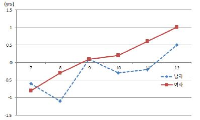
The aim of the study was to examine the tracking of body composition and physical fitness in boys and girls for 6 years. Thirty-seven boys and girls participated throughout the study. All measurements were performed annually. Body height, body weight, circumferences and skinfold thicknesses were measured and skeletal maturity was assessed. Body composition and bone mineral density were measured by DXA. Nine physical fitness tests were administered. Results of the study showed that there are significant interaction effects of time and group for body height(p<.01), waist circumference(p<.001), and skinfolds at triceps(p<.01), suprailiac(p<.01), thigh(p<.001) and medial calf(p<.01). All anthorpometric variables except skinfold thickness increased during the study period. Significant interaction effects of time and group were found for percent body fat(p<.05) and bone mineral density(p<.01). Percent body fat and fat tissue increased in boys from 7 to 11 years, then decreased in 12 years. Lean tissue(p<.001), bone mineral content(p<.001) and bone mineral density(p<.001) increased both in boys and girls throughout the study. There were significant interaction effect of time and group on sit and reach, standing long jump and sit-ups. In conclusion, percent body fat and fat tissue increased until 11 years, lean tissue and bone mineral density increased throughout the study both in boys and girls.
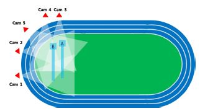
The purpose of the study was to investigate the relationship between the different kinematical variables with respect to the records and techniques performed by the participants during the 2011 Daegu IAAF World Championships Men's Pole Vault Event. Subjects chosen for the study were 8 male athletes who were selected for men's pole vault finals (highly skilled group) and 7 athletes who scored lowest record (skilled group) from the men's pole vault qualifying round. Personal best record of the each subjects were chosen to perform two dimensional (2D) and three dimensional (3D) video analyses. The data were obtained at 60 Hz with the use of five video cameras and digitizing was performed. Kinematical variables were calculated after smoothing the data using 2nd order Low-Pass Butterworth filter at cut-off frequency of 10 Hz and Independent samples t-test was performed to test any differences between two subject groups. The results: during the run-up stage, the horizontal velocity rate of the number of steps and run-up phase was obtained higher in highly skilled group than skilled group. During the take-off phase, deceleration in the horizontal velocity rate was observed in highly skilled group than skilled group. Distinct technical characteristics of distant and lower take-off of the take-off angle (angle of pole support) were also observed in highly skilled group than skilled group. During the pole bending and releasing phase, horizontal velocity was generally higher in highly skilled group than skilled group. It is considered that highly skilled group was able to jump higher as the vertical velocity during the pole bending as well as release phase was much higher in comparison to the skilled group.
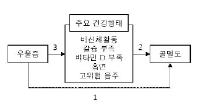
The purpose of this study was to investigate the relationship between depression and bone mineral density in Korean elder men (55+), and test mediating role of health behaviors. Korean National Health and Nutrition Examination Survey 2006-2011 data were analyzed. Bone mineral density was measured using DXA. Depression was measured by whether a participant had diagnosed depression, depressed mood lasted longer than 2 weeks, and/or suicidal thinking. Mediating health behaviors were serum vitamine D, calcium intake, high-risk drinking, endurance physical actiity, and resistance exercise. The associations among depression, health behaviors, and bone mineral density with demographic covariates were tested by linear regression, logistic regression, and path analysis. Diagnosed depression was not significantly associated with bone mineral density. Men who experienced substantial depressed mood and suicidal thinking has significantly lower bone mineral density than non-experienced counterparts. The effect of suicidal thinking on bone mineral density was mediated by endurance physical activity only. This study results suggest that elder men who experienced severely depressed mood and suicidal thinking were at-risk population for osteopenia. Also, physical activity intervention seems to be a priority to prevent osteoporosis comorbidity in depressed people.
This study aims to find the alternative to increase the participation rates of physical activities and to analyze socio-demographic factors that determine sporting participation in Korea. We estimates the sporting participation model with ʼ2012 national sport participation survey in Korea' and binary logit analysis. The results are as follows: sporting participation is positively related to gender(male), age, education level, household income, health status, leisure time in weekday, proximity to public and private sports facilities. The most significant factors influencing the raising the participation rates of physical activities factors are age and proximity to sports facilities. Therefore, to make many people to participate in sports activities, we need to supply the public sports facilities that in proximity to house and the facilities needs to be taken into participant's age such as elderly group. Also, we make effort to improve the accessibility to sports facilities of poor and unhealthy people.
The aim of this study is to analyze the correlation between per capita GDP and sports items' demand and to estimate the income elasticities of sports items' demand based on the International Social Survey Programme: Leisure Time and Sports - ISSP 2007 of the GESIS(Leibniz-Institute for the Social Sciences, Germany). The facts found from the analyses are as follows; First, in general, when the correlation coefficient of a particular sports item turns out to be both positive and statistically significant, the item can be interpreted to have a good possibility to be a luxury goods and when the coefficient is ascertained to be both negative and statistically significant, the item can be inferred to have a considerable chance to be an inferior goods. In this study, other team sports(excluding basketball, soccer, volleyball, baseball etc.), squash, walking/trekking/climbing, boat sports, hunting/fishing, horse riding/horse racing, motor sports, shooting, and snow sports were confirmed to show a luxury goods' features and basketball, soccer, volleyball, athletics, and martial arts were identified to have an inferior goods' characteristics. Second, similar to the results of the correlation analysis, in the income elasticities estimation, cockfighting appeared to be an inferior goods and other team sports, squash, walking/trekking/climbing, bowling/curling/bocce, boat sports, darts, hunting/fishing, golf/minigolf, horse riding/horse racing were proved to be a luxury goods.
