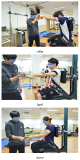
The purpose of this study was to explore and confirm Kumi-kata related factors of muscle strength by performance level in Korea elite female judoists. In order to achieve this purpose, 14 elite female judoists participated to this study. The subjects were divided to two groups (World Class Group and Non-World Class Group) according to their world ranking level(by ranked 30th). The analysis factors were repeated grip strength, Kumi-kata specific pulling strength and isokinetic strength of trunk joint. The results were as follows: Firstly, World Class Group had significantly higher repeated grip strength as compared to non-world class group (p<.001). Secondly, World Class Group had significantly higher specific Kumi-kata pulling strength as compare to non-world class group (p<.05). Finally, The differences between the two groups for isokinetic strength of trunk joint were non-significant. The results of this study indicates that a strong relationship exist between Kumi-kata related specific muscle strength and performance level in korea elite female judoists.
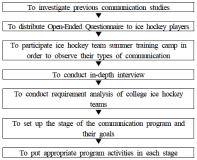
This study was designed to develop a communication training program for college ice hockey teams and examine the effects of this program. College ice hockey players and coaches participated in this study. The various types of data were collected and analyzed to assess the needs of the program and to develop the program with expert meetings. To analyze the effects of the developed program, questionnaires, experience reports, and in-depth interviews were conducted as measures. The results of this study are as follows. First, ice hockey team communication consisted of eight factors (i.e., sympathy, respect, trust, two-way verbal communication, firm expression of opinion, training program communication, developing rapport, and cohesion). Thus, the program developed based on eight factors and consisted of three stages of total 12 sessions which was 90 min to 100 min long. Second, this program increased communication satisfaction, coach-athlete interaction, group cohesion and exercise effectiveness, and these quantitative results were statistically significant. Moreover, qualitative analysis revealed that this program enhanced sympathy, social cohesion, and task cohesion among participants as well as positively changed their communication skills better than before. The communication training program which was developed through this study could provide basic information of a communication training program in the sports domain and positively influence overall sports team effectiveness and performance.
This study conducted to explore K-League (Korea Professional Football League) referees’ psychological experience and coping strategies just after the moment of wrong judgment. Open-ended questionnaire were conducted on 35 full-time referees who participated in the K-League winter training camp. The data were categorized by inductive content analysis. The results were as follows. Psychological experience yielded 45 raw data points, which were based on the following 10 sub categories; increased anxiety, rumination wrong judgment, concern about reprimand, and feeling apologetic; and four general categories including, psychological fragmentation, feeling helpless, concern about reputation, and acknowledgment of wrong judgment. Thus, K-league referees experience a psychological turbulence just after the moment of the bad calls and worsen feelings of helplessness about the wrong decisions. Also, K-league referees worry about further disadvantages following the misjudgement and admit their bad calls feeling sorry for teams and athletes who were in the incidents. Coping strategies yielded 55 raw data points from which the following categories were identified 11 sub categories; increasing concentration, attempting to forget wrong judgment, apologizing on wrong judgment, and change in thinking; and four general categories including, emotional self-support, avoiding situation, correcting the error and thinking, and changing of refereeing approach. Therefore, K-league referees enhance their concentration in order to not reoccur wrong judgement after the moment of the mistakes and try to forget the incidents of wrong judgement. Also, K-league referees apology to the teams and athletes who experienced the bad calls and make efforts to correct the mistakes if possible. Moreover, K-league referees try to modify a criteria of judgement in order to manage aftereffects of wrong judgement and make decisions correctly by approaching the scenes of the wrong judgement. The study emphasizes the importance of referee psychological stability on the field and the need for psychological support. The study is expected to encourage further research on sports referees in Korea to ensure they receive appropriate psychological support.
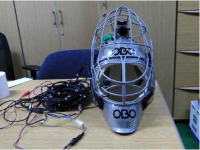
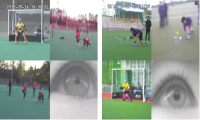
The purpose of this study is to establish the efficient defensive strategy from analyzing the goalkeeper’s gaze behavior and defensive motion in both field hokey penalty corner and penalty stroke. To achieve this goal, 3 national team goalkeepers’ gaze behavior and defensive motions were analyzed, as well as the player’s visual strategies from their interview contents. For the apparatus, multi-channel integrational system were used for analyzing goalkeeper’s reaction movement and personal visual strategies. The result is as follow: First of all, In the penalty stroke, goalkeepers were tended to focus on the bottom of the shooter’s hokey stick. Second, national hokey players had quicker anticipating saccadic movement. For this reason, their visual fixation locations were arrived in targets earlier than the hockey ball. Lastly, in the interview contents, they were reported to focus just on the ball from not disturbed by other various objects(body, hockey stick). However, they actually observed various body parts of shooters. These results imply that we need to develop an effective perceptual skill training in order to anticipate the shooting performance more accurately and rapidly. These types of perceptual and cognitive skill training should be conducted with information on knowing their specific visual cues in anticipating shooting direction.
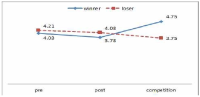
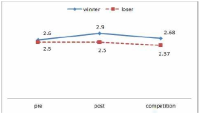
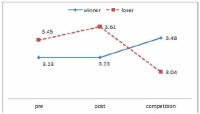
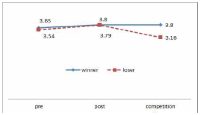
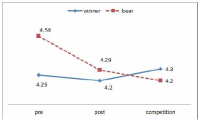
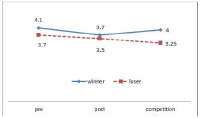
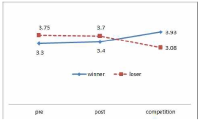
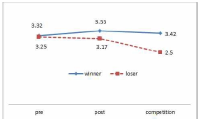
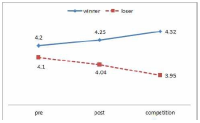
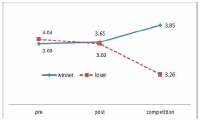
The purpose of this study was to confirm the differences between winner and loser groups of national team participated in the World Taekwondo Championships statistically and trends of psychological status according to applying mental coaching. In order to achieve the purpose it was the selection of 16 national members participated in the 2013 World Taekwondo Championships in Puebla. Data was selected by TOPS(test of performance strategy). The survey was conducted before and after applying the mental coaching and the game soon after. Data processing results were calculated utilizing Excel and SPSS 21.0 version. Based on the findings issue the conclusions were as follows. First, the psychological state of the winner and loser groups showed a different trend in the self-talk, emotion control, performed automatically, imagery, struggle, negative thinking, relaxation, condition factor. Winner group was shown maintenance or better trends of psychological state in the three times measurements on the other hand, loser group was shown decrease in the game soon after. Secondly, winner and loser groups are statistically significant differences in the psychological state of competition in self-talk, struggle, negative thinking, solving tension factors. In other words, The winner group had higher score in the four factors than loser group in the competition.
This study was to identify the structure of anger behavior that athletes illustrated in competitions. In order to achieve research purpose, 167 high school, college, and professional athletes responded to open questionnaires. Targeting 541 players, the structural validity of psychological measurement was verified. As a result of analyzing the sources of anger behaviors during matches, four factors of anger-out, anger-in, anger control, and anger-helplessness were deduced. Afterwards, the validity of 4 factor-model was verified through correlation analysis with trait anger and verification of group differences. That is, the level of trait anger had a positive relationship with expression of anger-out and anger-helplessness while it had a negative relationship with anger-in and anger-control. Especially, the behavioral aspect such as anger-helplessness is a structure that has not been found in other criteria of anger behavior and it reflects the uniqueness of sports situation. Based on such results, the significance of sport anger behavior and implications were discussed.

Vertical jumping is one of basic skills in many sports activities. Maximizing vertical jumping performance requires large “power”, which implies that one should generate force against the ground in a short period of time. In order to gain better understandings of how human musculo-skeletal system mechanically functions to achieve maximal power in vertical jumping, the proposed “dynamic catch” mechanism, one of “power amplification” mechanisms through the role of muscle-tendon interaction, was specifically reviewed base on the morphological and mechanical characteristics of lower limb muscle-tendon complex. By understanding basic structural and functional features of human muscle-tendon interaction, this review aims to provide basic scientific information for training and rehabilitation and promote convergence researches in related areas, such as sports biomechanics, mechanical engineering, and sports medicine.


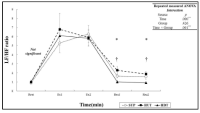
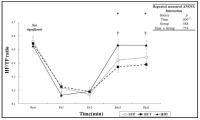
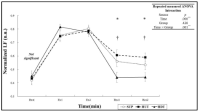
This study was aimed at investigating the effect of head-tilt angle on autonomic nerve modulation immediately after a single bout of exercise in twenty-three healthy young males(age 21.96 ± .4 yrs). Post-exercise HRV was measured on supine(SUP), -15°head-down tilt(HDT), and +15°head-up tilt(HUT) followed by 20 min aerobic exercise with moderate intensity(40% of VO2max). As results, heart rate recovery during post-exercise on each tilt angle(SUP vs. HDT vs. HUT) had no significant difference(p> .05). Also, there were no significant difference in time and nonlinear domain index of HRV. On spectral analysis; however, frequency domain index(HF, LF/HF ratio, HF/TP ratio, HF nu, LF nu) had significant difference(p< .05) on each tilt angle at recovery. Especially, PNS reactivation index (HF, HF/TP ratio, HF nu) had significant increase on HDT compared to HUT(p<. 05) while SNS activation index (LF/HF ratio, LF nu) had significant decrease on HDT compared to HUT(p<. 05). Furthermore, there were significant interaction between recovery time elapsed and each tilt angle (except for HF/TP ratio). In conclusion, -15°head-down tilt promotes the effective cardiac vagus nerve reactivation immediately after a single bout of aerobic exercise.



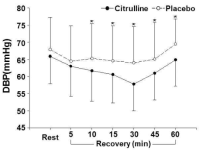
It has well known that post-exercise hypotension (PEH) after a bout of aerobic exercise was a major mechanism to reduce blood pressure though exercise training, and that citrulline supplementation reduced blood pressure by increasing nitric oxide in vivo. However, the effects of citrulline supplementation on PEH have not been fully elucidated yet. This study was designed to examine the effects of citrulline supplementation on PEH after a bout of aerobic exercise in prehypertensive and normotensive 20s males. The effects of a four-day citrulline or placebo treatment on blood pressure, cardiovascular function, and blood lactate concentration measured at rest and during recovery phase after a bout of exercise performed for 30 min at 70% VO2max were compared and analyzed. All subjects participated in a citrulline trial and a placebo trial repeatedly according to a counter-balanced order. Main results of the present study were as follows: 1) Systolic blood pressure, diastolic blood pressure, and mean arterial pressure measured at 10-60 min of recovery phase in citrulline trial were significantly lower than placebo trial. Rate-pressure product measured at 30 min and 45 min of the recovery phase in citrulline trial was significantly lower than placebo trial. 2) No significant differences were found in heart rate (HR), cardiac output (CO), and total peripheral resistance (TPR) measured during the recovery phase between two trials. There were significant differences in HR, stroke volume, CO, and TPR among times within a trial. 3) No significant difference was found in blood lactate concentration measured at rest and during the recovery phase between two trials. The results would be summarized that the PEH was augmented by the citrulline supplementation, and that burden to cardiac muscle as well as cardiovascular function were not affected by the citrulline supplementation. It was concluded that the short-term citrulline supplementation would be very effective to augment the PEH. A research investigating the effects of citrulline supplementation on the PEH in pre-hypertensive and/or hypertensive individuals would be warranted. In addition, a study examining the effects of citrulline supplementation during long-term exercise training on the blood pressure in hypertensive patients also would be warranted in near future.
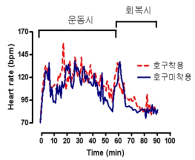
The purpose of this study was to investigate the effect of wearing of safeguard devices on various blood ions (i.e., Na+, K+, Ca2+) concentrations, gas parameters (PO2, PCO2, hematocrit [Hct], hemoglobin [Hb], Saturated [Sat] O2), and energy substrates (i.e., glucose, free fatty acid [FFA], lactate) concentrations during Kumdo training. Research scope extended to examine the heart rate changes during each exercise sessions. In order to achieve the research goal, 10 male elite Kumdo players, who play for G city in Gyeongsangbuk-do, were participated, and their mean maximum oxygen uptake level was 51.2(±6.1)mL· kg-1min-1. All subjects undertook Kumdo training sessions twice, which carefully pre-planned and consisted of routinely carrying out exercise program. Training period for each session was 80 min long including 10 min each for warm-up and warm-down period, but the conditions with wearing body protection devices were different following either with wearing complete set of safeguard devices or without wearing any safeguard devices except general training cloth. Heart rate was measured by every minute interval. K+ and Ca2+ showed interaction effect between the conditions with wearing safeguard devices and conditions with time of Kumdo training. Hct and Hb level significantly increased after 60 min Kumdo exercise regardless of wearing safeguard devices. Kumdo training induced dropping of blood pH independently with wearing safeguard device conditions, however the values and/or concentrations of PO2, Na+, glucose, lactate, Sat O2were significantly increased. Heart rate was maintained marginally higher values throughout exercise period when safeguard devices were worn. Based on these results, it was concluded that wearing the safeguard devices could possibly be causing a physiological metabolic changes, and this may be drawn by increased body fluid loss and energy expenditure. Further study should be undertaken to examine the effects of wearing safeguard devices on hitting intensity and hormone secretion and concentrations, that closely associated with body fluid and ion balance during Kumdo exercise and/or training.
